Outer solar system may face early chaos as gas giants collide after Sun's demise
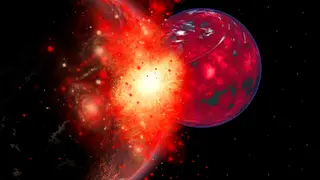
New simulations suggest that the gravitational interactions among Jupiter, Saturn, Uranus, and Neptune will spiral into instability just a few billion years after the Sun exhausts its nuclear fuel, leading to potential collisions. This timeline is significantly earlier than previous models predicted, indicating a more turbulent end for the outer solar system. The findings highlight how stellar evolution can dramatically reshape planetary systems.
New computer simulations indicate that the outer solar system—home to Jupiter, Saturn, Uranus, and Neptune—could experience a dramatic period of instability just a few billion years after the Sun exhausts its nuclear fuel. This event, occurring much earlier than previously thought, may trigger gravitational cascades leading to potential collisions among the gas giants. The timing is significant: rather than remaining relatively stable during the Sun’s red giant and white dwarf phases, the planetary system may descend into chaos within a few hundred million years after the Sun's core fusion ends. These findings challenge prior models that assumed long-term stability in the outer solar system even after stellar death.
The background for this shift lies in evolving understanding of how stellar evolution influences planetary dynamics. Earlier simulations had projected gradual changes or delayed instability, but new modeling techniques incorporating post-main-sequence gravitational interactions suggest a much more turbulent trajectory. While no specific organizations or researchers are named in the summary, such work typically emerges from astrophysics teams at major research institutions using advanced computational tools. These scientists aim to refine predictions about planetary system longevity and the fate of solar systems across the galaxy.
What remains unresolved is whether these simulations accurately reflect real-world conditions, as they rely on assumptions about mass
This discovery could reshape public understanding of the solar system’s long-term fate, shifting perceptions from a stable, enduring structure to one prone to dramatic collapse. While the timeline is far beyond human existence, it may influence science education, inspiring new curricula on stellar and planetary evolution. The broader impact may extend to space policy and long-term planning for interstellar missions, as even distant future scenarios could inform risk assessments for probes or habitats. Institutions like NASA and ESA may use such findings to refine mission design for deep-space exploration, particularly for missions targeting the outer planets. Comparable to how the discovery of exoplanets in the 1990s revolutionized astronomy, this research may catalyze renewed interest in planetary system dynamics. What to watch for next is whether these simulations are validated by future observations or if they prompt new theoretical frameworks—though no immediate changes in policy