Invisible Tattoos Reveal Art with UV Light and Vanish Under White Light
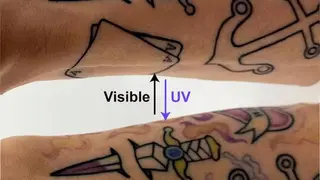
Scientists at the University of Colorado Boulder have developed a photochromic tattoo ink that remains invisible under normal light but activates to reveal colorful designs when exposed to ultraviolet light. The ink uses light-sensitive dyes that undergo reversible molecular changes: UV light triggers a structural shift that produces color, while intense white light reverses the process and fades the image. This technology could enable temporary, customizable body art with applications in fashion, personal expression, and even medical monitoring.
In November 2026, researchers led by Carson Bruns at the University of Colorado Boulder unveiled a breakthrough in photochromic tattoo ink technology, publishing their findings in the journal *Matter & Light*. The innovation, named PhotoTat, uses light-sensitive dyes encapsulated in poly(methyl methacrylate) (PMMA)—a biocompatible polymer already approved for medical use in bone cement and intraocular lenses. These inks remain invisible under normal white light but activate to reveal vibrant colors when exposed to ultraviolet (UV) light, with the image fading again under intense white light. The team demonstrated multiple designs, including a glowing lantern and rainbow fish scales, using four distinct pigments—red, blue, magenta, and yellow—capable of combining into 16 additional hues. While red ink, marketed as Magic Ink by Colorado-based biotech company Hyprskn, was already available in 2024 at £77 per 2 ml vial, the new formulations expand creative possibilities. However, challenges persist: the blue variant degrades after only 10–100 activation cycles, leaving a permanent purple residue, and ambient sunlight can unintentionally trigger the ink. Despite promising stability—over 10,000 on-off cycles without degradation—the inks require extensive toxicity and safety testing before commercial rollout. Bruns envisions medical applications beyond fashion, such as temporary skin markers for radiation therapy that can be deactivated once treatment ends, reducing psychological bu
This development could reshape personal expression by enabling dynamic, reversible body art, appealing to individuals seeking flexibility in identity presentation—such as professionals who wish to conceal tattoos during work hours. The technology may also influence the tattoo industry’s business model, potentially introducing premium, high-tech services with limited availability and high cost. While early adoption is likely among tech-savvy or fashion-forward consumers, broader acceptance hinges on safety validation and affordability. A comparable precedent is the gradual integration of photochromic lenses in eyewear, which faced initial skepticism before becoming mainstream after reliability improved. Similarly, public trust in these tattoos may grow only after long-term safety data emerges. The medical applications—especially for temporary clinical markers—could have significant ethical and psychological implications, offering a way to reduce stigma linked to permanent marks from ill