Rocket Lab hits 99 launches with successful deployment of Japanese radar satellite
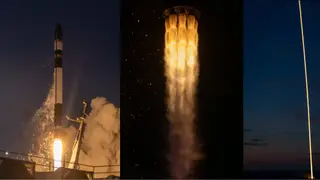
Rocket Lab successfully launched its 99th mission, deploying a synthetic aperture radar (SAR) satellite for Japan’s iQPS company using its Electron rocket. The satellite, part of a growing Earth-imaging constellation, was released at an altitude of 575 kilometers, marking the 10th launch for iQPS aboard Electron. The mission, named "The Sea God Surveys," highlights Rocket Lab’s ongoing role in providing dedicated rideshare services for small satellites.
On November 2, 2026, Rocket Lab successfully executed its 99th launch overall and 90th orbital mission using its Electron rocket, deploying a synthetic aperture radar (SAR) satellite for Japan’s iQPS company in a mission named “The Sea God Surveys.” The launch occurred at 11:41 a.m. EST from Rocket Lab’s facility in New Zealand, marking the 17th flight of Electron that year. The satellite was released into a 575-kilometer orbit after a 40-minute coast phase following second-stage burnout and kick stage deployment. This mission represented the 10th launch for iQPS aboard Electron, advancing their goal of building a constellation of 36 SAR satellites to deliver high-resolution, near-real-time Earth imagery regardless of weather or daylight conditions. Rocket Lab’s fleet includes nine suborbital HASTE missions since June 2023, used primarily for hypersonic technology testing with classified payloads, but this flight was part of the standard orbital Electron program.
The success underscores Rocket Lab’s growing role in dedicated rideshare services for small satellites, particularly in niche markets like radar imaging. iQPS, a Tokyo-based company, relies on these launches to rapidly scale its commercial SAR constellation, which offers data critical for environmental monitoring, disaster response, and defense applications. The consistent 100% mission success rate across all ten iQPS launches reflects reliability and trust between the two companies. Prior to this launch, Rocket Lab
This mission highlights the expanding commercialization of space infrastructure, particularly for Earth observation. iQPS’s SAR constellation could significantly enhance global monitoring capabilities, especially in regions with persistent cloud cover or limited daylight, benefiting sectors like agriculture, climate science, and emergency response. The reliability of Rocket Lab’s Electron rocket—now with 90 successful orbital flights—may encourage more small satellite operators to adopt dedicated launch services over shared rides, potentially reshaping the economics of smallsat deployment. Comparable in impact to the early days of SpaceX’s Falcon 9, which transformed access to space through reusability and reliability, Rocket Lab’s consistent performance may be fostering a new era of predictable, frequent smallsat launches. However, the long-term sustainability of such constellations remains uncertain, particularly regarding orbital debris and spectrum congestion. What to watch for nex