Tiny Invisible Forces Are Undermining Ultra-Sensitive Devices Without Physical Contact
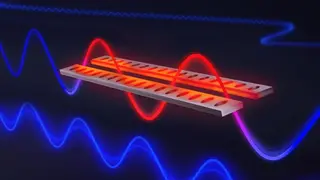
Researchers at EPFL have identified a previously unknown nanoscale phenomenon that disrupts the vibrational stability of ultra-sensitive mechanical sensors, even when no physical contact occurs. The effect arises from insulating materials placed just a few hundred nanometers away, interfering with device performance through non-contact interactions. This discovery could reshape the design and placement of nanomechanical systems in quantum and precision sensing applications.
Researchers at EPFL have uncovered a previously unrecognized nanoscale phenomenon that compromises the vibrational stability of ultra-sensitive mechanical sensors, even in the absence of physical contact. The effect occurs when insulating materials are positioned just a few hundred nanometers away from these devices, disrupting their performance through non-contact interactions. This distance—on the order of hundreds of nanometers—was not previously considered significant enough to influence sensor behavior, making the discovery particularly surprising. The findings challenge long-held assumptions about how such systems operate in isolation and highlight the importance of environmental factors at the nanoscale.
The background for this discovery lies in the increasing sophistication of nanomechanical systems used in quantum sensing and precision measurement technologies. As devices shrink and sensitivity increases, even subtle disturbances can degrade performance. Prior research focused on direct contact or electromagnetic interference, but this study reveals a new class of interaction rooted in material proximity without touch. The implications are significant for fields requiring extreme precision, such as quantum computing, gravitational wave detection, and atomic-scale imaging.
The primary organization involved is EPFL, a leading Swiss research institution known for innovation in materials science and nanotechnology. Their work aims to refine the design and placement of
This discovery could reshape how nanoscale devices are engineered in high-precision applications, affecting industries ranging from semiconductor manufacturing to medical diagnostics. Devices relying on mechanical resonance—such as atomic force microscopes or quantum sensors—may need redesigned layouts to avoid proximity to insulating materials, potentially altering production processes and increasing design complexity. The impact may ripple through research labs and tech companies developing next-generation instruments, where even minor performance drifts can compromise results. A comparable case is the discovery of Casimir forces in the 1940s, which similarly revealed invisible quantum interactions between closely spaced objects—initially overlooked but later critical for nanoscale device design. Just as Casimir effects now inform microelectromechanical systems (MEMS), this new phenomenon may become a standard consideration in nanotechnology. What to watch for is whether other inst