Markets Open November on Mixed Notes Amid Tech Sell-Off and Energy Reversal
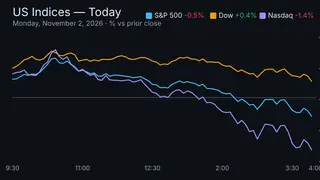
U.S. stock indices opened November with divergent performances, as the Dow Jones rose 0.41% while the Nasdaq fell 1.07% and the S&P 500 dipped 0.51%. The decline was driven by a rotation out of tech stocks, particularly AI-related names, amid concerns over rising capital expenditures, while energy shares plunged on hopes for a Middle East ceasefire. Defensive assets like gold rose, and sectors tied to fuel costs—such as airlines and housing—gained strength.
U.S. stock indices opened November 2, 2026, on a mixed note, with the Dow Jones Industrial Average gaining 0.41% to close at 51,983.98, while the Nasdaq Composite plunged 1.07% to 25,164.32 and the S&P 500 declined 0.51% to 7,541.40. The divergence was driven by a sharp rotation out of technology stocks—particularly AI-related names—amid growing concerns over escalating capital expenditures. Oracle’s announcement of a $20 billion fundraising plan for AI infrastructure and Marvell’s $115 billion all-stock acquisition of Lumentum intensified investor caution, sending Computer Storage Devices down 7.51%. Simultaneously, energy stocks tumbled as diplomatic progress between the U.S., Iran, and Qatar raised hopes for a Middle East ceasefire and the reopening of the Strait of Hormuz, causing WTI crude to drop 7.78% to $96.02. This decline fueled gains in fuel-sensitive sectors: Scheduled Air Transportation surged 6.37%, Aircraft Engines & Engine Parts rose 4.03%, and Operative Builders climbed 4.03%. Defensive assets like gold rose 1.45% to $3,955.50, while the VIX spiked 9.01% to 21.17, signaling heightened market anxiety. Key upcoming events include Apple and Palantir’s Q3 earnings after the close on November 2, U.S. midterm elections on November 3, and the October Nonfarm Payrolls report on November 6.
The shift reflects broader investor sentiment pivoting from high-growth tech to value and cyclical sectors amid macroeconomic uncertainty. The energy sell-off underscores how geop
The market’s divergence on November 2 highlights how geopolitical optimism can quickly reshape sector performance, particularly in energy-dependent industries. A potential Middle East ceasefire could reduce supply constraints, lowering oil prices and benefiting sectors like aviation and housing—industries that influence consumer spending and inflation expectations. This shift may ease cost pressures for households and businesses, potentially supporting broader economic growth. However, the sharp sell-off in tech stocks—especially AI-related firms—could signal a broader reassessment of valuations amid rising capital demands, which may affect innovation funding and long-term productivity. Comparable to the 2022 tech selloff following rate hikes, this rotation may reflect a recalibration of risk appetite rather than fundamental deterioration. The impact on investors is mixed: those in energy and value stocks may see short-term gains, while tech holders face volatility. What’s next could d