Genomics and Precision Medicine Stocks Rally After Recent Downturn
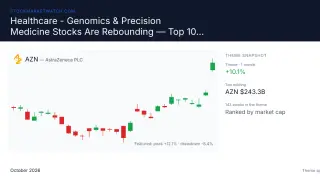
The genomics and precision medicine sector rebounded in October, with its median stock rising 3.1% over the past week after a 6.1% decline in the prior three months. The top performers included AstraZeneca, Regeneron, and Illumina, all showing strong momentum and outperforming broader market benchmarks. The resurgence reflects renewed investor confidence in biotech innovation and personalized medicine platforms.
The genomics and precision medicine sector posted a notable rebound in October, with its median stock rising 3.1% over the past week following a 6.1% decline in the preceding three months. This recovery was driven by strong performances from major players such as AstraZeneca (AZN), Regeneron (REGN), and Illumina (ILMN), which saw one-month gains of 18.4%, 26.3%, and -11.2% respectively, with Regeneron and Vertex Pharmaceuticals (VRTX) leading in relative strength at 92 and 90. The broader theme includes 143 stocks focused on gene therapy, genetic testing, and personalized medicine platforms, with 69% of its members advancing during the recovery period. AstraZeneca, the top-ranked company by market cap at $243.3 billion, continues to lead in oncology and precision medicine applications, while Thermo Fisher Scientific (TMO) and Danaher (DHR) serve as key enablers through their life sciences tools and diagnostics infrastructure. The resurgence follows a period of investor caution amid regulatory scrutiny and valuation corrections in biotech, particularly after the 2023–2024 downturn in high-growth healthcare stocks.
The underlying momentum reflects renewed confidence in biotech innovation, especially in therapies targeting rare diseases and cancer through genetic insights. Regeneron’s success with Eylea and its oncology pipeline, Vertex’s breakthroughs in cystic fibrosis gene therapy, and Natera’s liquid biopsy technology are indicative of the sector’s clinical and commercial p
The rebound in genomics and precision medicine stocks could signal a broader shift toward long-term investment in personalized healthcare, potentially accelerating innovation in diagnostics and targeted therapies. Patients with rare diseases or complex cancers may benefit from faster access to treatments as companies like Vertex and Regeneron scale their platforms. However, the benefits are likely to be uneven: large-cap firms with strong balance sheets and institutional backing will gain disproportionate advantage, while smaller biotechs may struggle to secure funding amid selective market enthusiasm. This dynamic mirrors the dot-com bubble’s aftermath, where a few dominant tech firms emerged while many others failed—similar concentration risks exist in today’s biotech landscape. The healthcare system may also face increased pressure if these therapies command premium prices without clear cost-effectiveness data. Investors and regulators will need to monitor pricing models and real-wo