Apple Stock Slumps on Margin Warnings Despite Strong Earnings
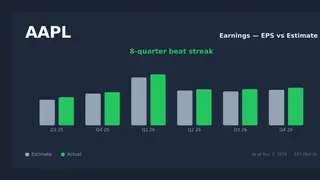
Apple's stock fell 4% despite beating earnings expectations, as management signaled weaker holiday quarter margins due to soaring memory costs across all its devices. While Microsoft dipped and Meta held steady, Apple’s guidance for December gross margins below consensus sparked investor concern. The company raised purchase obligations by $33 billion but still anticipates supply constraints for Macs and iPads.
Apple reported fiscal Q4 earnings for 2026 on November 2, posting revenue of $114.48 billion—slightly above the $113.46 billion consensus—and EPS of $2.10, beating estimates by $0.10. Despite this strong performance, driven largely by iPhone sales totaling $57.58 billion, Apple’s stock dropped 4% to $325 in pre-market trading, marking a 6% decline over the past week. The key divergence came from guidance: CFO Kevan Parekh projected December-quarter gross margins between 45% and 46%, below the 46.3% analyst consensus, citing “unprecedented” memory pricing across all devices. This cost pressure stems from AI-driven demand for memory chips, which affects every product Apple sells—iPhones, Macs, iPads, and even cloud-based Siri services. To secure supply, Apple increased purchase obligations by $33 billion in the quarter, yet still expects supply constraints for Macs and iPads during the holiday season. The company’s Services revenue of $31.57 billion met expectations, but growth was forecast at only 8%–9%, below the 10.7% estimate. CEO John Ternus, who recently succeeded Tim Cook, emphasized that memory costs are not a temporary issue and will persist beyond the current quarter.
The broader tech landscape reveals a stark contrast: Microsoft dipped 1%, Meta held steady, and Alphabet was flat—highlighting how Apple’s position as a hardware-focused consumer company makes it uniquely vulnerable to input cost inflation. Unlike its peers, which benefit from AI infrastructure spending
Apple’s margin warning could signal broader vulnerability across consumer electronics, where rising semiconductor costs may pressure profit margins beyond Apple’s ecosystem. As memory prices surge due to AI-driven demand, other hardware manufacturers—especially those reliant on similar supply chains—may face similar challenges, potentially leading to higher device prices or reduced innovation cycles. The contrast with Microsoft and Meta, whose stocks held firm despite modest declines, underscores a growing divergence between infrastructure-focused tech firms and consumer hardware producers. This dynamic may accelerate investment shifts toward cloud and AI services providers, while slowing capital allocation to physical product development. A comparable precedent is the 2018 semiconductor shortage, which disrupted smartphone production and led to price increases; however, that was supply-constrained, whereas today’s issue stems from demand-driven cost inflation. What could follow is a w