Geologists Solve Mystery of Missing Billion Years in Earth's Rock Record
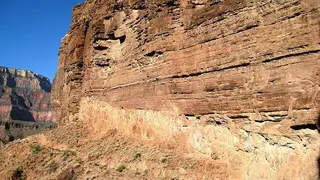
Scientists have identified that massive erosion caused by ancient ice sheets scraping across uplifted continents erased up to a billion years of Earth’s geological history. This process, known as the Great Unconformity, explains gaps in rock layers found globally, including in the Grand Canyon. The findings link this event to the Cambrian explosion of life due to changes in ocean chemistry.
Between approximately 920 million and 420 million years ago, ancient continental blocks—Laurentia (modern North America), Baltica (northern Europe), and North China—were uplifted by slow-moving hot rock in Earth’s mantle, a process known as mantle convection. This upward motion exposed their deep crystalline basement rocks at the surface, making them vulnerable to erosion. During the Neoproterozoic era, particularly between 720 million and 635 million years ago, these uplifted continents were subjected to massive ice sheets during the Snowball Earth period. These glaciers, more effective at eroding rock than rivers, scoured away sedimentary layers that had accumulated over hundreds of millions of years, creating the so-called Great Unconformity—a gap in the geological record spanning up to a billion years. This phenomenon is visible today in places like the Grand Canyon, where 540-million-year-old sedimentary rock lies directly atop 2-billion-year-old basement rock. The research, led by geoscientist Santosh Dhungana and conducted using Australia’s Gadi supercomputer, models this uplift and subsidence cycle, showing that the sinking of these continents after erosion allowed new sediment layers to form—preserving the younger rock while the older record was lost. Prior theories had included mountain-building, sea-level changes, or volcanic activity, but none accounted for the global pattern of missing rock across multiple continents. The study’s findings link this geological event to the Cambrian explosion, suggesting that erosion released nutrients into oceans, altering chemistry and enabling rapid diversification of animal life. What remains unresolved is whether similar uplift patterns occurred in other regions like Australia and South America—where evidence of the Great Unconformity is minimal—due to different tectonic histories. The exact timing and extent of ice sheet coverage during Snowball Earth, and how it varied across continents, also requires further investigation.
This discovery could reshape how geology and paleontology interpret Earth’s deep history, particularly in understanding the conditions that enabled complex life. By linking the Great Unconformity to a major environmental shift—glacial erosion altering ocean chemistry—it may influence climate modeling and evolutionary timelines, especially around the Cambrian explosion. Institutions like museums, universities, and geological surveys may revise educational materials and exhibit displays to reflect this new narrative. The findings could also impact resource exploration, as understanding ancient erosion patterns helps predict where sedimentary basins—potential reservoirs for oil or minerals—might be preserved. A comparable case is the 19th-century debate over uniformitarianism versus catastrophism, which transformed geology by establishing that slow processes shape Earth over time. This study similarly shifts perspective from random gaps to a predictable tectonic-ice cycle. While not yet altering policy, it may prompt funding agencies to prioritize mantle dynamics and paleoclimatic modeling. What to watch for next is whether similar uplift-erosion patterns can be identified in other continents using new data or satellite-based geophysical surveys. The broader implication is that Earth’s surface history is more dynamic and interconnected than previously thought—where tectonics, climate, and life may be deeply entwined across vast timescales.