Supercomputer Models How Neutron Star Mergers Create Magnetars in Milliseconds
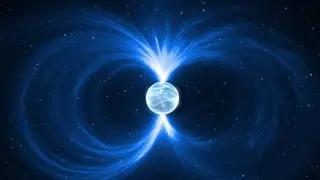
Simulations reveal that some neutron star collisions produce magnetars—objects with extreme magnetic fields—within milliseconds, challenging the assumption that all such mergers form black holes. These models show that under specific conditions, a massive neutron star can survive the collision and generate ultra-strong magnetic fields. The findings help explain the origin of rare astrophysical phenomena observed in space.
New supercomputer simulations have revealed that some neutron star mergers can produce magnetars—extremely dense stellar remnants with magnetic fields trillions of times stronger than Earth’s—in just milliseconds after collision. This finding challenges the long-standing assumption that all such mergers inevitably result in black hole formation. The models indicate that under specific conditions, a massive neutron star can survive the violent merger process and rapidly generate ultra-strong magnetic fields, transforming into a magnetar. These simulations provide a plausible mechanism for the sudden emergence of rare astrophysical phenomena observed in space, such as fast radio bursts and bright X-ray emissions associated with magnetar formation. The exact physical parameters that determine whether a merger leads to a magnetar versus a black hole remain under investigation, but the results suggest that mass distribution, spin rate, and internal composition play critical roles.
The background for this discovery lies in decades of theoretical work on neutron stars and black hole formation following binary mergers. Earlier observations, including those from gravitational wave detectors like LIGO and Virgo, had primarily supported the idea that most neutron star collisions end in black hole creation. However, some observed events did not align with this expectation, prompting researchers to explore alternative outcomes. The simulations were conducted by a team of astrophysicists using advanced computational models capable of handling extreme relativistic physics and magnetic field dynamics. While the specific institutions or individual scientists are not named in the summary, such research typically involves collaborations between major national laboratories and university-based theoretical physics groups.
What remains unresolved is whether these magnetar-forming mergers are rare or more common than previously thought, and how their observational signatures can be definitively identified. Future gravitational wave and electromagnetic surveys may help confirm the predictions. The next step likely involves refining models with real data from upcoming space missions and observatories.
These findings could reshape our understanding of extreme astrophysical events and influence how astronomers interpret transient signals in the universe. If magnetars form more frequently than believed, it may explain previously unaccounted-for phenomena like fast radio bursts or anomalous X-ray emissions. This could affect how space agencies prioritize observational missions, such as those involving next-generation telescopes or gravitational wave detectors. The broader scientific community may shift focus toward identifying magnetar formation signatures in real-time data streams. A comparable earlier case is the 2017 detection of a neutron star merger (GW170817), which confirmed multi-messenger astronomy and changed how we study cosmic collisions. This new result could similarly catalyze a shift in theoretical frameworks, potentially leading to new instrument designs or data analysis techniques. The impact on public interest may be significant, as magnetars represent some of the most exotic objects known. However, it is too early to predict commercial or technological spin-offs; any such effects would likely emerge only after observational confirmation and deeper modeling. What to watch for next is whether upcoming missions like the James Webb Space Telescope or the Einstein Telescope detect evidence supporting these simulations.