Ancient Underwater Canyons Preserved Earth's Earliest Soft-Bodied Fossils
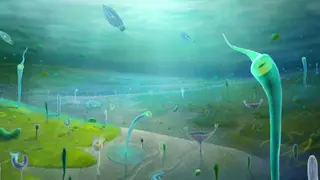
A study led by Adelaide University researchers reveals that deep underwater canyons formed during a drop in sea level preserved some of the planet’s oldest animal fossils in South Australia. When sea levels rose again, these canyons were rapidly filled with sediment, shielding soft-bodied Ediacaran organisms from erosion and storms. The findings suggest global sea-level fluctuations may have played a key role in fossil preservation across multiple regions.
More than 540 million years ago, during the Late Ediacaran period, a dramatic shift in global sea levels played a crucial role in preserving some of Earth’s earliest soft-bodied animal fossils in what is now South Australia’s Flinders Ranges. Researchers from Adelaide University, led by Dr. Karol Faehnrich, studied the base of the Ediacara Member rock layer and discovered deep underwater canyons—up to 280 meters deep and nearly 6 kilometers wide—cut into the ancient continental shelf. These valleys, oriented southeast, were likely carved during a period of falling sea level when parts of the shelf were exposed, allowing rivers to contribute to their formation. When sea levels rose rapidly again, these canyons were swiftly filled with sediment from underwater landslides and turbidity currents, burying the seafloor and shielding delicate soft-bodied Ediacaran organisms from erosion and storm damage. This rare preservation window allowed for the exceptional fossil record seen today, including species like Quaestio simpsonorum. The study’s findings are supported by extensive fieldwork involving over 3,000 meters of rock logging and satellite-derived elevation mapping. Similar patterns of sea-level fluctuation have been observed in rocks of comparable age in Eastern Europe, suggesting a global phenomenon. While the exact mechanisms driving these sea-level swings remain unclear, the research underscores how climate-driven geological changes may have influenced fossil preservation across multiple regions. The work was published in Earth and Planetary Science Letters in 2027, offering new insight into the environmental conditions that enabled the survival of some of life’s earliest complex forms.
This discovery could reshape how paleontologists interpret fossil preservation in other ancient sedimentary basins, particularly those from the Ediacaran period. By linking sea-level changes to exceptional fossilization, it may prompt re-evaluation of similar deposits worldwide, potentially revealing new fossil sites or refining dating models. Institutions focused on geological archives and museum collections may prioritize revisiting older samples with this framework in mind. The study also highlights how climate-driven geological events—such as rapid sea-level rise—can create rare preservation windows, which could inform future research into early life’s evolution. A comparable precedent is the Burgess Shale in Canada, where exceptional preservation was attributed to rapid burial by mudslides; here, sea-level fluctuations may have played a similarly pivotal role. While not yet confirmed, this model could influence how we assess fossil potential in deep-time environments. What remains uncertain is whether these sea-level shifts were driven by glacial cycles or tectonic processes—key details that could affect broader climate reconstructions. Future research may explore isotopic records from the same strata to test hypotheses about global climate dynamics during the Ediacaran, potentially linking biological evolution to planetary-scale environmental change.