Student List Secures Absolute Majority in Serbia’s First Opposition Victory in 14 Years
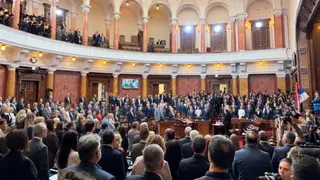
After a historic electoral victory, the Student List secured an absolute majority in Serbia’s National Assembly, marking the first time since 2012 that the long-ruling Serbian Progressive Party (SNS) has lost control of parliament. The new legislature convened on November 17, with the Student List winning 140 seats compared to SNS’s 103. The session included symbolic gestures from the student movement, though their request to observe from the gallery was denied. MPs will now elect a speaker, deputies, and other key parliamentary roles.
On November 17, 2026, Serbia’s National Assembly convened for its constitutive session following a landmark parliamentary election on October 25, 2026, in which the Student List secured an absolute majority with 140 seats, defeating the long-ruling Serbian Progressive Party (SNS), which won 103 seats. This marks the first time since 2012 that the SNS has lost control of parliament, ending a 14-year dominance marked by repeated electoral victories and centralized power. The Student List, formed by a student-led movement that emerged after the Novi Sad railway station canopy collapse in November 2024—killing 16 people—gained 53% of the vote (2.35 million), compared to the SNS’s 39% (1.73 million). Turnout reached a record 68.9%, up from 58.8% in the 2023 elections, signaling heightened civic engagement. Despite symbolic gestures—such as the removal of an SNS tent camp in Pionirski Park and a student-led protest outside parliament—the movement was denied access to observe the session from the gallery, a decision attributed to the Secretary General of the National Assembly. The session, chaired by the oldest MP, SNS’s Stojan Radenovic, will now proceed with confirming mandates, electing a speaker, and forming parliamentary bodies. A 90-day deadline for forming a new government begins upon constitution of the Assembly.
The Student List, composed largely of experts, professors, and public figures selected by students, represents a shift from traditional party politics toward a movement-based, youth-driven reform agenda. Its leaders, including Ana Dimitrijevic and Aleksandar Baucal, have publicly committed to advancing European integration, strengthening the rule of law, and building functional institutions. This aligns with EU Enlargement Commissioner Marta Kos’s recent engagement with Student List MPs, underscoring international attention on Serbia’s democratic trajectory. However, unresolved issues remain: the exclusion of student observers raises questions about institutional openness, and the new government’s ability to deliver on reform promises amid potential resistance from entrenched interests. The full impact of this shift—especially on judicial independence, media freedom, and economic policy—remains to be seen.
The Student List’s victory could signal a broader societal shift toward youth-led political engagement in Eastern Europe, echoing the 2011–2012 protests in Serbia and the 2018–2019 anti-government demonstrations in Lebanon and Chile. If sustained, this could reshape the political landscape not just in Serbia but across the Western Balkans, where youth disillusionment with traditional parties is widespread. The new government may prioritize transparency, anti-corruption measures, and EU alignment, potentially influencing regional dynamics and investor confidence. However, the exclusion of student observers from the session may fuel perceptions of institutional resistance to change, possibly undermining legitimacy in the eyes of younger voters. The EU may increase pressure on Serbia to meet accession criteria, especially regarding judicial reform and media independence. What remains uncertain is whether the Student List can maintain cohesion and deliver on promises amid the complexities of governance. The next 90 days will be critical: if a stable government forms, it could mark a turning point; if not, the political momentum may stall.