IEA Projects Global CO2 Emissions to Drop to 36 Billion Tonnes by 2035 Amid Coal Phase-Out
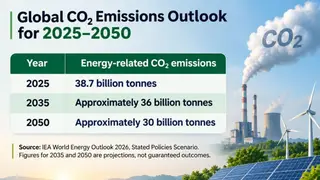
Global energy-related CO2 emissions reached 38.7 billion tonnes in 2025, according to the IEA, with projections showing a decline to 36 billion tonnes by 2035 under current policy scenarios. The reduction is driven primarily by a shift away from coal, especially in China and advanced economies, which together account for over 90% of the projected emissions drop. Emissions from passenger vehicles are also expected to fall nearly 10% by 2035 due to electric vehicle adoption and efficiency gains.
Global energy-related CO2 emissions reached 38.7 billion tonnes in 2025, according to the International Energy Agency (IEA), with projections indicating a decline to 36 billion tonnes by 2035 under current policy scenarios. This reduction, amounting to roughly 7 percent, is primarily driven by a sharp decline in coal-fired power generation, especially in China and advanced economies, which together account for over 90% of the projected emissions drop. China is expected to reduce its emissions by 1.9 billion tonnes by 2035, largely due to falling coal use and declining output in energy-intensive industries like steel and cement. Meanwhile, passenger vehicle emissions are projected to fall nearly 10% by 2035, fueled by electric vehicle adoption and improved fuel efficiency. In contrast, India’s emissions are forecast to keep rising until around 2040, reflecting its growing energy demand from industrialization and urbanization. The EU, Japan, South Korea, and Australia are projected to cut emissions by about 30% by 2035, supported by coal phase-out commitments and energy efficiency policies. The IEA’s analysis highlights a divergence between national climate pledges and actual policy implementation, noting that while 136 countries have updated their Nationally Determined Contributions (NDCs), these commitments do not guarantee policy action. The long-term outlook remains uncertain: under current policies, global warming could reach 2.5°C by 2100, falling short of the Paris Agreement’s 1.5°C target.
The IEA’s projections signal a pivotal shift in global energy dynamics, with coal’s decline accelerating in key economies and renewable adoption gaining momentum. This could reshape energy markets, particularly in power generation and transportation, where electric vehicles and clean electricity may displace fossil fuels faster than anticipated. Industries reliant on coal and heavy manufacturing may face structural adjustments, especially in emerging economies like India, where emissions are still rising. The contrast between China’s early peak and India’s delayed one underscores differing development paths and policy readiness. Comparable to the 2015 Paris Agreement, where initial pledges were seen as insufficient but catalyzed action, today’s updated NDCs may serve as a benchmark for future policy alignment. However, the gap between stated goals and actual implementation remains a critical risk. What may unfold next is whether governments translate pledges into enforceable regulations, particularly in regions with high growth and energy demand. Monitoring policy enforcement, investment in clean infrastructure, and international cooperation will be essential indicators of whether the 2035 emissions target becomes a reality.