MIT and Cornell Team Develop Insect-Sized Robot Capable of Autonomous Flight
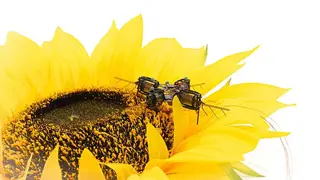
Engineers from MIT and Cornell University have created a 1.29-gram flying robot that mimics insect flight using onboard sensors and a miniature computer. The robot can hover, avoid obstacles, and land on surfaces without relying on external tracking systems. It holds potential for aiding crop pollination and exploring hazardous environments.
In November 2026, engineers from MIT and Cornell University unveiled a 1.29-gram flying robot capable of autonomous flight using onboard sensors and a miniature computer, marking a significant leap in micro-robotics. The robot, roughly the weight of a paper clip, can hover, avoid obstacles, and land on delicate surfaces like flowers—demonstrated in a 30-second flight guided by a joystick over four feet (1.2 meters). It processes sensor data—including acceleration, rotation, altitude, and ground-relative movement—at 480 times per second, enabling real-time flight stabilization despite wing flapping at 330 Hz. The onboard computer, weighing just 244 milligrams, is integrated into a frame that includes redesigned artificial flight muscles, which were enhanced by 46% to compensate for added weight. Unlike earlier micro-drones reliant on external motion-tracking systems in lab settings, this robot operates independently, a breakthrough for field applications. The team’s findings were published on the preprint server arXiv, signaling early-stage validation before peer review.
The development builds on decades of research into biomimetic robotics, particularly inspired by the flight agility of insects like fruit flies. Prior attempts at small-scale flying robots were limited by the need for external cameras and centralized computing, restricting operation to controlled environments. This new design overcomes that by integrating sensing and computation into the robot itself. MIT and Cornell researchers aim to advance robotics for real-world use, particularly in agriculture and hazardous exploration. Their long-term vision includes robotic insects that could assist in crop pollination in greenhouses, where natural pollinators are hard to manage. However, key challenges remain: the robot still depends on an external power supply, lacks autonomous flower recognition, and cannot collect or transfer pollen. Future iterations will need to integrate lightweight batteries and more advanced navigation systems to achieve full autonomy. The current prototype is a lab proof-of-concept, but it demonstrates that insect-sized machines can carry the computational and sensory load needed for independent flight.
This development could influence agriculture, environmental monitoring, and disaster response by enabling new forms of robotic intervention in delicate or inaccessible environments. In greenhouses, insect-sized robots may one day supplement or replace bees in pollination, especially in controlled settings where natural pollinators face threats from pesticides or habitat loss. While the current robot cannot yet perform pollination tasks, its ability to land on fragile surfaces and navigate without external tracking suggests a viable path forward. The technology may also impact search-and-rescue operations, where micro-drones could enter collapsed buildings or disaster zones to locate survivors, reducing risk to human teams. A comparable precedent is the development of early drones for military reconnaissance, which evolved from lab prototypes into widespread civilian tools. Similarly, these insect robots may eventually transition from research curiosities to practical tools, though their adoption will depend on overcoming energy, autonomy, and scalability hurdles. What to watch for next includes progress in onboard power sources, machine learning for autonomous navigation, and potential regulatory frameworks for deploying swarms of micro-robots in public or ecological spaces.