UK and EU Seal Trade, Carbon, and Youth Mobility Agreements Amid Fee Dispute
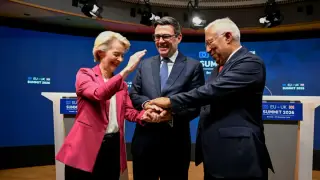
UK Prime Minister Andy Burnham and EU leaders Ursula von der Leyen and Antonio Costa finalized three agreements in Brussels on November 20, 2026, covering trade, carbon markets, and youth mobility. The UK claims the deals will boost its economy by $22 billion, but EU nations are withholding implementation until Britain agrees to lower university fees for EU students. The agreements mark a renewed push for post-Brexit cooperation despite unresolved tensions.
On November 20, 2026, UK Prime Minister Andy Burnham, European Commission President Ursula von der Leyen, and European Council President Antonio Costa finalized three agreements in Brussels aimed at easing post-Brexit tensions. The deals cover streamlined food exports, integration of carbon markets, and a youth mobility scheme allowing up to 100,000 under-30s from each side to live and work in the other for up to three years. Burnham claimed the agreements would boost the UK economy by $22 billion, framing them as a corrective to the “hard Brexit” of 2016. The agreements were initiated under his predecessor, Keir Starmer, and represent a significant step toward reintegration in key economic and social areas. However, implementation remains contingent on the UK agreeing to reduce university tuition fees for EU students to match domestic levels—a condition EU nations have made clear they will not waive. Despite Burnham’s assertion that “the deal is done,” EU officials signaled they would withhold implementation until progress is made on fees, highlighting a persistent rift over education costs. Burnham has also signaled openness to long-term rethinking of UK-EU relations, including the possibility of rejoining the EU, though he emphasized that public opinion and parliamentary constraints limit immediate action. The summit marked a shift from the earlier, more adversarial tone of post-Brexit diplomacy, reflecting both the UK’s economic challenges and Europe’s strategic alignment on issues like Ukraine.
The agreements could significantly ease trade and mobility for young professionals and agricultural exporters, potentially revitalizing cross-border economic activity. For EU students, the unresolved fee issue may continue to deter enrollment in UK universities, undermining the youth mobility scheme’s intended impact. The UK’s economic recovery may benefit from reduced trade barriers, but long-term gains depend on deeper institutional alignment, which remains politically sensitive. This moment echoes the 2018 Brexit negotiations, where symbolic progress was offset by unresolved core issues—here, the fee dispute may similarly stall broader integration. The EU’s conditional stance reflects a broader trend of using policy leverage to influence partner behavior, particularly in education and migration. What may follow is a prolonged negotiation phase, with potential for incremental progress or renewed deadlock. The outcome could shape future UK electoral strategies, as Burnham seeks to build a centre-left coalition around pro-European policies. Monitoring public opinion, especially among younger voters and university communities, will be crucial in determining whether this diplomatic thaw translates into lasting political change.