Sand Dunes on Other Worlds Reveal Wind Speeds Through Grain Dynamics
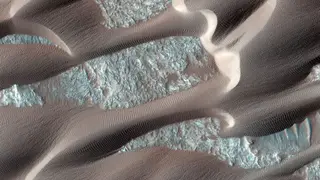
Stanford researchers led by M. Colin Marvin have developed a method to measure wind speed on alien worlds by analyzing the size and motion of sand grains in dunes. The study, published in the Proceedings of the National Academy of Sciences, uses the principle of saltation—where grains bounce and kick up others—to infer wind speeds from dune patterns. The technique applies to Mars, Venus, Titan, and even Comet 67P/Churyumov-Gerasimenko, where wind-like vapor flows shape surface features.
In November 2026, Stanford University researchers led by PhD student M. Colin Marvin published a study in the Proceedings of the National Academy of Sciences revealing a new method to measure wind speeds on alien worlds using sand dune dynamics. The technique hinges on analyzing grain size and motion patterns, particularly the process of saltation—where wind lifts grains that then bounce and dislodge others—allowing scientists to infer wind speeds from dune morphology. The team studied 24 terrestrial dune fields, from Utah’s Coral Pink Sand Dunes to Namibia’s Namib Sand Sea, and found that sand movement peaks when wind speeds are just above the transport threshold. On Mars, dunes composed of 0.2 mm grains are primarily mobilized by winds of 26 km/h at 10 meters above the surface. These findings were validated through simulations using the ReSCAL model, which confirmed that dunes form most efficiently under common, moderate winds rather than rare, violent storms. The method applies not only to Earth and Mars but also to Venus, Titan, and even Comet 67P/Churyumov-Gerasimenko, where vapor flows mimic wind-driven processes. The research builds on earlier observations from missions like Rosetta and Curiosity, which detected dune-like features on comets and ancient Martian sandstone layers. Future missions, including NASA’s Dragonfly lander to Titan in the 2030s, will use this framework to decode wind histories from grain size data. What remains unresolved is how to reliably measure grain size from orbit, a challenge that may limit immediate application on distant worlds.
This discovery could reshape how planetary scientists interpret surface features across the solar system, transforming dunes from passive indicators of wind direction into active records of atmospheric history. By enabling estimates of wind speed from grain size, the method may help refine climate models for Mars, Titan, and Venus—worlds with complex, poorly understood weather systems. For space agencies and mission planners, this could improve landing site selection and instrument targeting, particularly for upcoming missions like Dragonfly. The approach may also influence how we assess habitability, as wind-driven processes can redistribute organic material or alter surface chemistry. A comparable precedent is the use of crater density to date planetary surfaces, which revolutionized lunar and Martian geology in the 1960s and 70s. Just as that method became foundational, this grain-based wind analysis could become standard in planetary science. However, its real-world impact depends on future mission data and the ability to resolve grain size from remote sensing—still a technical hurdle. What to watch for next is whether this model is adapted for exoplanet surface studies, should high-resolution imaging ever become feasible.