Senators Push for Final Earmark Wins Before Democratic Takeover
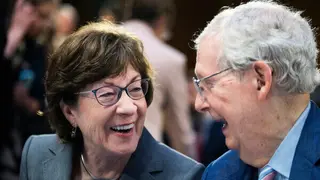
Senators Susan Collins and Mitch McConnell are leading efforts to secure $8.7 billion in congressionally directed spending across draft fiscal 2027 appropriations bills, aiming to lock in benefits for their states before Democrats take control. The draft bills include nearly 4,000 earmarks, with most requests coming from Republicans, though Democrats also submitted significant numbers. Democrats plan to delay final passage until next year, potentially reshaping the distribution of funds.
In late November 2026, newly released draft fiscal 2027 appropriations bills revealed that 78 senators secured $8.7 billion in congressionally directed spending, with Sens. Susan Collins (R-Maine) and Mitch McConnell (R-Ky.) leading the charge. The nine draft bills contain nearly 4,000 earmarks, most from Republicans, though 44 Senate Democrats and two independents also submitted requests—only Maggie Hassan of New Hampshire declined to seek funding. Despite Republican dominance in the number of projects, GOP-only earmarks received about 53% of the total $8.7 billion, or $4.6 billion. McConnell and Collins each secured over $400 million in the even-split ranking, placing them among the top three in all three evaluation methods—total dollar value, joint-credit count, and solo earmarks. Washington state led all states with $528.1 million, driven by Democratic senators Patty Murray and Maria Cantwell, while larger states like Texas, Florida, and California received zero earmarks due to GOP senators not requesting funds. The political backdrop includes Democrats’ intent to delay final passage until early 2027, possibly using a continuing resolution to push full-year bills into the next Congress, where they could reshape funding distribution. This strategy could nullify the final efforts of outgoing Republican leaders like Collins and McConnell, who may see their legacy projects vanish if no agreement is reached before Dec. 11, when a government shutdown looms without a funding deal.
The surge in earmarks before a partisan transition reflects a long-standing pattern of legislative last-minute bargaining, reminiscent of the 2008-2009 period when Republicans pushed through large spending packages before losing control. This year’s effort could deepen regional disparities in federal investment, favoring smaller, often rural states with senior Republican delegations while larger, more Democratic states receive less. The outcome may affect public infrastructure, research funding, and local economic development in recipient states, while non-recipient states may perceive the process as unfair. If Democrats delay final passage, it could strain federal agency planning and disrupt grant cycles, particularly for programs tied to fiscal year timelines. The influence of seniority and party control over funding allocation may further entrench political power imbalances. What’s next could depend on whether a bipartisan compromise emerges or if the delay leads to a government shutdown, which would shift public attention away from earmark politics and toward broader fiscal stability. The long-term impact on trust in Congress may hinge on whether such spending is seen as transparent and merit-based or as a partisan power grab.