South Korea Seeks Greater Investment in Sindh’s Industrial and Infrastructure Projects
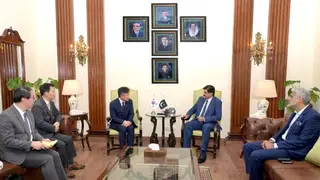
On November 20, 2026, South Korean Ambassador Han Seung-ho met with Sindh Chief Minister Syed Murad Ali Shah to discuss expanding bilateral economic ties. The ambassador highlighted growing interest from Korean companies in investing in Sindh’s industrial, technology, and infrastructure sectors, including automobiles, electronics, and water treatment. The Chief Minister formally invited Korean firms to participate in development projects, citing the successful Hyderabad-Mirpurkhas Road as a model of Korean-Pakistani cooperation.
On November 20, 2026, South Korean Ambassador Han Seung-ho met with Sindh Chief Minister Syed Murad Ali Shah at the Chief Minister’s House in Karachi to discuss expanding economic cooperation between South Korea and Pakistan’s Sindh province. The meeting included South Korean Counselor Son Young-sung and Researcher Ahn Hye-sun. Ambassador Han highlighted that Korean firms, already active in Islamabad and Faisalabad, are now showing strong interest in investing in Sindh’s industrial, technology, and infrastructure sectors—particularly in automobiles, electronics, and water treatment. The Chief Minister formally invited Korean companies to participate in development projects, citing the Hyderabad-Mirpurkhas Road—a public-private partnership completed with Korean involvement—as a successful model of bilateral collaboration. The Sindh government emphasized its commitment to facilitating foreign investment and fostering long-term partnerships, aiming to boost manufacturing, exports, and employment through Korean technological expertise.
This development builds on existing diplomatic and economic ties between Pakistan and South Korea, with prior investments in infrastructure and industrial zones. The focus on Sindh reflects a strategic shift toward provincial-level engagement, leveraging the province’s geographic and economic potential. The Sindh government seeks to attract foreign capital to diversify its economy beyond traditional sectors, while South Korea aims to expand its footprint in South Asia amid broader regional investment trends. However, the article does not specify the scale of proposed investments, timelines for project implementation, or the formal mechanisms for investor facilitation. It remains unclear whether this meeting will lead to binding agreements or merely initiate exploratory discussions.
The proposed investment could significantly impact Sindh’s economic landscape by modernizing infrastructure and stimulating industrial growth, potentially creating jobs and improving access to clean water and energy through advanced Korean technology. If realized, such projects may enhance regional connectivity and attract further foreign direct investment into Pakistan’s underdeveloped provinces. The success of the Hyderabad-Mirpurkhas Road as a model suggests that well-managed public-private partnerships can deliver tangible benefits, possibly encouraging similar collaborations in other sectors. However, challenges such as bureaucratic delays, regulatory uncertainty, or local opposition could hinder progress. A comparable case is South Korea’s earlier infrastructure support in Bangladesh, where initial projects laid the groundwork for broader economic engagement. What remains to be seen is whether this initiative will translate into sustained investment or remain a diplomatic gesture. Monitoring future announcements on project launches, investment pledges, and implementation timelines will be key to assessing its real-world impact.