ESA's Hera Probe Reaches Binary Asteroids After NASA's Deflection Test
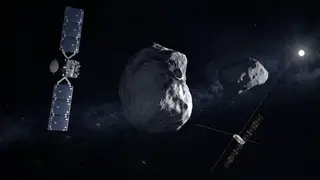
The European Space Agency’s Hera probe has arrived at the Didymos and Dimorphos binary asteroid system, where NASA previously tested planetary defense by altering Dimorphos’s orbit. The mission aims to study the impact crater and assess the effectiveness of kinetic deflection. This follow-up is critical for validating real-world strategies to protect Earth from hazardous asteroids.
In October 2026, the European Space Agency’s Hera probe successfully reached the Didymos-Dimorphos binary asteroid system, the site of NASA’s 2022 Double Asteroid Redirection Test (DART). DART, launched in November 2021, collided with Dimorphos—a 151-meter-wide moonlet orbiting the 780-meter-wide Didymos—at a speed exceeding 13,000 mph, successfully shortening Dimorphos’s orbital period by 33 minutes. This marked the first real-world test of kinetic deflection, a key planetary defense strategy. Hera’s mission now focuses on assessing the long-term effects of the impact, including analyzing the crater, measuring Dimorphos’s mass with precision, and studying how debris ejection altered the system’s dynamics. The probe, which flew by Mars in 2025 and began its approach phase in October 2026, captured its first images from 800 miles away and released its first detailed images of Didymos in early November. Hera carries two CubeSats—Juventas and Milani—scheduled for deployment in January 2027. Juventas will use ground-penetrating radar to probe up to 100 meters beneath Dimorphos’s surface and measure gravitational changes caused by Didymos’s influence, while Milani will analyze surface composition and search for dust and regolith. The mission is critical for validating whether kinetic impact can reliably deflect hazardous asteroids, a capability essential for Earth’s long-term safety.
The broader context includes the 1908 Tunguska Event and the upcoming 2029 close approach of asteroid Apophis, which underscores the real-world stakes of planetary defense. While NASA’s DART mission was a technical success, questions remain about the long-term stability of deflection outcomes and the role of material strength versus gravity in crater formation. ESA’s Hera mission fills a crucial gap by providing post-impact data that can refine models and inform future missions. The collaboration between NASA and ESA highlights a growing international effort to develop space-based defense systems. What remains unknown is how such deflection strategies would perform on larger or more complex asteroids, and whether the observed effects on Dimorphos would scale to more dangerous objects. The results from Hera’s instruments—especially its lidar and spectrometers—could reshape how we assess asteroid threats and design response systems.
The Hera mission’s findings could significantly influence how governments and space agencies plan for asteroid threats, potentially shaping future funding and policy decisions on planetary defense. With Apophis expected to pass within 19,000 miles of Earth in 2029—closer than many satellites—public and governmental interest in deflection technologies is likely to grow. The success of DART and the follow-up by Hera may encourage greater investment in autonomous space missions and international cooperation, similar to how the Apollo program spurred innovation in computing and materials science. The deployment of CubeSats like Juventas and Milani could also inspire new models for low-cost, high-impact planetary exploration, potentially expanding access for academic and commercial entities. Comparable to the 1998 Near-Earth Object Survey, which led to the creation of NASA’s Planetary Defense Coordination Office, Hera’s data may catalyze the formation of a permanent international monitoring and response framework. What to watch for next is whether the results prompt a shift from reactive observation to proactive mission planning, possibly including early-warning systems or even test missions on larger asteroids. The outcome may not be immediate, but could lay the groundwork for a coordinated, science-based approach to safeguarding Earth.