Fossil Discovery in Brazil Reveals 236-Million-Year-Old Silesaurid Species That Bridges Dinosaur Origins
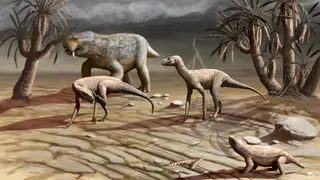
Paleontologists have identified a new species, Itaguyra occulta, from fossil remains in southern Brazil dating to the Early Carnian period, approximately 236 million years ago. This silesaurid, a close relative of dinosaurs, fills a critical gap in the fossil record, showing that these animals persisted in Gondwana for at least 11 million years across major ecological shifts. The discovery supports the theory that dinosaurs may have originated earlier than previously thought, with silesaurids potentially representing a sister group or early branch of ornithischian dinosaurs.
Paleontologists have identified a new silesaurid species, *Itaguyra occulta*, from fossil remains discovered at the Schoenstatt Sanctuary site in Santa Cruz do Sul, Rio Grande do Sul, Brazil. Dated to approximately 236 million years ago, the fossils—consisting of a hip and lower pelvic bone—come from the Early Carnian period, filling a critical gap in the fossil record between Middle Triassic and Late Triassic silesaurid finds. This discovery demonstrates that silesaurids persisted in Gondwana for at least 11 million years, surviving a major ecological turnover when tusked dicynodonts declined and rhynchosaurs rose to dominance. The species was named after the Itaguyra River region and the Latin *occulta*, meaning "hidden," reflecting its long-unrecognized status in a collection labeled “indeterminate.” The study, led by Dr. Voltaire Paes Neto from the Federal University of Rio de Janeiro and published in *Scientific Reports* in May 2025, uses phylogenetic analysis to suggest *Itaguyra occulta* may represent one of the earliest ornithischian dinosaurs, challenging the traditional timeline that places dinosaur origins at the end of the Ladinian (~241 million years ago). If confirmed, this implies dinosaurs or their immediate ancestors were present and ecologically active for millions of years before their sudden diversification in the Late Triassic. The research team, including collaborators from Brazilian institutions, seeks to refine the evolutionary narrative of early dinosaurs, particularly the relationship between silesaurids and ornithischians. However, the exact phylogenetic placement remains debated—whether silesaurids are sister to dinosaurs or an early branch of ornithischians—leaving the origin of dinosaurs still unresolved.
The discovery of *Itaguyra occulta* could influence how public and academic audiences perceive the timeline of dinosaur evolution, shifting the narrative from a sudden Late Triassic explosion to a longer, more gradual emergence. This may reshape science education materials, museum exhibits, and popular media portrayals of dinosaur origins, emphasizing continuity over abrupt change. Institutions like natural history museums and science communication platforms may update their displays to reflect earlier dinosaur presence, potentially increasing public interest in paleontology and fossil preservation. The finding also underscores the importance of re-examining museum collections—what were once labeled as “indeterminate” specimens may hold significant revelations—suggesting that underfunded or overlooked collections could yield future breakthroughs. A comparable precedent is the 2017 discovery of *Nyasasaurus*, which similarly challenged established timelines of dinosaur origins. While not yet confirmed as a true dinosaur, it sparked debate over early dinosauriforms. Similarly, *Itaguyra occulta* may not definitively resolve the silesaurid-dinosaur relationship, but it strengthens the argument for earlier origins. What to watch for next is whether additional fossils from the same period in South America or other Gondwanan regions will support the continuous presence hypothesis. The scientific community may also see renewed efforts to date and analyze older Triassic deposits, especially in underexplored regions like southern Brazil, where the Santa Cruz Sequence has proven fertile.