Hawking Stars: How Captured Primordial Black Holes Could Reveal Dark Matter
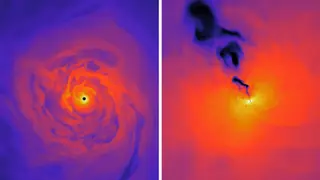
A new study led by MIT’s Ore Gottlieb proposes that primordial black holes (PBHs) in the asteroid-mass range could be detected by observing stars that have engulfed them—so-called Hawking stars. These stars would undergo internal destruction, producing a detectable flash as the PBH consumes the star from within. The research uses stellar evolution models to predict how such events would manifest, offering a potential pathway to test whether PBHs constitute dark matter.
In November 2026, a study led by MIT physicist Ore Gottlieb proposed a novel method to detect primordial black holes (PBHs) by observing stars that have captured them—so-called "Hawking stars." The research, published in The Astrophysical Journal, focuses on PBHs in the asteroid-mass range (10¹⁷ to 10²³ grams), a mass window where such objects could have survived since the early universe and potentially constitute dark matter. These PBHs, theorized to have formed in the first fractions of a second after the Big Bang, are invisible to conventional detection due to their lack of electromagnetic interaction. The study models how a PBH, once captured by a star—likely through gravitational interactions in a binary system—could migrate to the star’s core over thousands to millions of years. Once there, two distinct fates emerge: if the PBH forms an accretion disk due to rapid rotation, it launches powerful relativistic jets that destroy the star explosively within seconds; if not, the star fades quietly, leaving behind a stellar-mass black hole indistinguishable from others. The explosive scenario would produce a transient signal detectable across X-ray, optical, infrared, and radio wavelengths, resembling a supernova but with a distinct origin. The work builds on Stephen Hawking’s earlier theoretical framework and leverages modern stellar evolution models to simulate these rare events. While no such event has been observed, the study provides a testable prediction for future surveys.
This research could influence how astronomers search for dark matter, shifting focus from direct particle detection to indirect astrophysical signatures. If Hawking stars produce observable transients, large-scale sky surveys like the Vera C. Rubin Observatory’s LSST could detect them, potentially confirming or ruling out PBHs as dark matter candidates. This would impact cosmology, astrophysics, and particle physics, as resolving dark matter’s nature affects models of galaxy formation and the universe’s large-scale structure. The study may also stimulate new observational campaigns and data analysis techniques tailored to short-lived, multi-wavelength transients. A comparable precedent is the detection of gravitational waves from black hole mergers, which transformed astrophysics by opening a new observational window. Similarly, if Hawking star transients are found, they could validate long-standing theoretical models and reshape our understanding of early-universe physics. However, the absence of confirmed detections so far means the existence of asteroid-mass PBHs remains speculative. What’s next could include targeted searches in archival data or real-time monitoring of variable sources, though the rarity of such events means confirmation may take decades.