LISA May Detect Exoplanets Through Gravitational Wave Signatures in Binary Systems
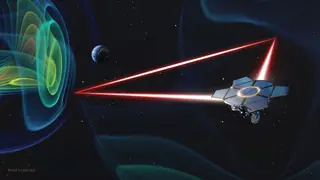
New research shows that the Laser Interferometer Space Antenna (LISA), set for launch in 2035, could detect exoplanets by identifying subtle perturbations in gravitational wave signals from binary systems. Specifically, the presence of an orbiting planet around a double white dwarf system imprints a measurable signature on the wave pattern. Postdoctoral researcher Casey McGrath and colleagues from the University of Maryland and NASA’s Goddard Space Flight Center are leading this work, which expands LISA’s potential beyond black hole mergers.
In November 2026, postdoctoral researcher Casey McGrath from the University of Maryland and NASA’s Goddard Space Flight Center published two papers in The Astrophysical Journal detailing how the Laser Interferometer Space Antenna (LISA), scheduled for launch in 2035, could detect exoplanets through gravitational wave signatures. LISA, an ESA-led mission, will consist of three spacecraft forming an equilateral triangle in space, using laser interferometry to detect ripples in spacetime. The new research focuses on double white dwarf binary systems—common sources for LISA—where an orbiting exoplanet could perturb the system’s center of mass, imprinting a detectable Doppler shift on the gravitational wave signal. This method, dubbed gravitational-wave radial velocity (GWRV), mirrors the traditional radial velocity technique used in optical astronomy but applies it to gravitational waves instead of starlight. Unlike conventional methods, GWRV is more sensitive to high-mass, long-period planets and can probe post-main-sequence stellar systems where electromagnetic observations have found fewer exoplanets. The work builds on prior knowledge of LISA’s primary mission to study black hole mergers and cosmic expansion but extends its scientific reach. However, challenges remain: LISA’s orbital motion introduces a Doppler effect that must be corrected, and any exoplanet signal would require confirmation via electromagnetic observations. The full potential of GWRV depends on future, more complex analyses.
If validated, LISA’s ability to detect exoplanets via gravitational waves could transform planetary science by revealing worlds in stellar systems previously inaccessible to observation. This would be especially impactful for understanding planetary formation around evolved stars like white dwarfs, where current methods are limited. The multimessenger approach—combining gravitational wave data with infrared or optical follow-up—could strengthen exoplanet confirmation and deepen our understanding of stellar evolution. Comparable to how the discovery of gravitational waves in 2015 opened a new observational window in astronomy, LISA’s potential exoplanet detection could catalyze new research directions and funding in astrophysics. Institutions like ESA, NASA, and academic centers may prioritize exoplanet-related data analysis in future missions. However, the technology remains years from deployment, and the method’s sensitivity and false-positive rates are still unknown. The broader impact may be felt in public engagement with space science, as the idea of “hearing” planets through spacetime ripples could inspire new generations of scientists. What to watch for: whether upcoming simulations and test models can isolate exoplanet signals from instrumental noise, and how the scientific community integrates gravitational wave data into existing exoplanet catalogs.