Raúl Esparza Leads Rock Musical Galileo in New Broadway Production
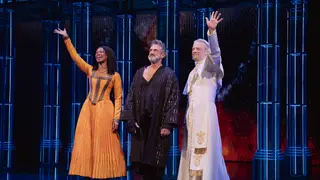
Raúl Esparza stars in Galileo, a new rock musical about the 17th-century astronomer’s clash with the Catholic Church. The show, with music by Zoe Sarnak and Michael Weiner and a book by Danny Strong, dramatizes Galileo’s revolutionary discoveries and his trial. It premieres at the Shubert Theatre, blending history with contemporary rock music to explore the scientist’s legacy.
In 1610, Galileo Galilei, an Italian mathematician and astronomer, revolutionized observational science by constructing a telescope and using it to discover mountains on the Moon, four moons orbiting Jupiter, and countless previously invisible stars—findings he detailed in his groundbreaking work *The Starry Messenger*. These observations challenged the long-standing geocentric model, which held that Earth was the immovable center of the universe. By 1616, the Catholic Church had declared heliocentrism—proposed by Nicolaus Copernicus in 1543—as “foolish and absurd in philosophy,” effectively silencing Galileo’s public advocacy. Despite this, Galileo maintained a close relationship with Cardinal Maffeo Barberini, who became Pope Urban VIII in 1623. Galileo believed he had secured the Pope’s approval to write about competing cosmological models, provided he presented them as hypothetical. However, in 1632, his *Dialogue Concerning the Two Chief World Systems* presented the heliocentric view in a way that many saw as mocking the Church’s position, particularly through the character of Simplicio, a caricature of the geocentric stance. This led to his trial by the Inquisition in 1633, resulting in house arrest for the remainder of his life. The rock musical *Galileo*, with a book by Danny Strong, music by Zoe Sarnak and Michael Weiner, now dramatizes this complex historical saga at New York’s Shubert Theatre, starring Raúl Esparza in the title role. The production blends historical events with contemporary rock music to explore the tension between scientific inquiry and institutional authority.
The musical *Galileo* could resonate deeply in an era marked by renewed public scrutiny of science, institutional power, and the role of dissent in shaping knowledge. By framing Galileo’s struggle as a rock musical, the production may attract younger audiences unfamiliar with 17th-century scientific debates, potentially reinvigorating interest in science communication and the history of ideas. The choice to center a major Broadway production on a scientist’s clash with religious authority may also spark dialogue about modern parallels—such as climate change denial or vaccine skepticism—where evidence-based reasoning confronts entrenched belief systems. Comparable to the 1960s play *Inherit the Wind*, which dramatized the Scopes Trial as a metaphor for intellectual freedom, *Galileo* may serve as a cultural touchstone for debates about truth, authority, and the courage to challenge orthodoxy. While the show’s commercial success remains uncertain, its thematic weight could influence educational programming, inspire related theatrical works, or prompt discussions in science and humanities curricula. What remains to be seen is whether the musical’s blend of history and rock spectacle will deepen public understanding of Galileo—or simply entertain.