IDS launches industrial 3D time-of-flight camera with robust depth sensing
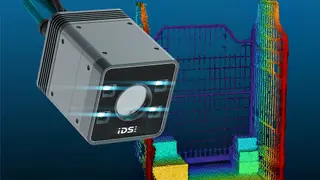
IDS Imaging Development Systems has introduced the Nion, an industrial time-of-flight camera with 1.2-megapixel resolution and integrated depth processing. The camera delivers stable depth data at 30 fps even under rapid motion and changing lighting, making it suited for logistics, automation, and robotics. It features an IP67-rated housing, Power over Ethernet, and uses onsemi's AF0130 sensor for high accuracy in demanding environments.
The Nion camera builds on IDS Imaging's established presence in machine vision, a field the German company has served since its 1997 founding. With roughly 320 employees across 21 countries and a catalog approaching 5,000 products, IDS has positioned itself as a mid-sized but globally active player in both 2D and 3D imaging systems. The new ToF camera extends that reach into depth-sensing applications.
The camera's operational envelope spans distances from 0.3 to 7.5 meters, covering typical warehouse and factory floor scenarios. Its IP67 rating means protection against dust ingress and temporary water immersion, while Power over Ethernet simplifies installation by carrying both data and power through a single cable. The underlying onsemi AF0130 sensor represents a newer generation of indirect time-of-flight technology aimed at improving ambient light rejection and motion stability.
Industrial 3D sensing could reshape warehouse and factory workflows by enabling machines to react to their environment in real time. Logistics operators may use such cameras to automate parcel handling or quality checks that currently require human judgment, potentially shifting labor demands toward system oversight rather than manual sorting. Robotics developers could integrate this depth data to improve navigation and object grasping, which may accelerate automation adoption among mid-sized manufacturers. However, the pace of deployment will depend on integration costs and workforce retraining needs, meaning benefits may arrive unevenly across industries and regions.