Glacial Collapse in Himalayas Sparks Deadly Flash Floods
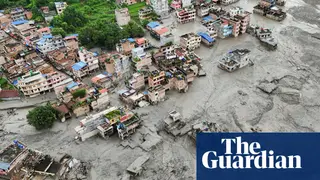
A massive glacial collapse in the Himalayas caused flash floods that killed at least 165 people and left over 1,000 missing. The event was initially reported as an earthquake but was later determined to be a glacial rock and ice collapse. The floods swept through valleys, destroying buildings and washing away roads.
The collapse occurred at 8.37am Wednesday in Langtang national park, roughly 60km north of Kathmandu. Seismic readings initially suggested a magnitude 4.4 earthquake, but the US Geological Survey revised this to a 5.2 glacial rock and ice collapse. The resulting debris flow tore through the Lhende Khola, Bhote Koshi and Trishuli river valleys, destroying bridges and submerging multi-level buildings in riverside towns.
Officials reported 826 missing in Nepal, including 579 foreign tourists from roughly two dozen countries, while Chinese state media listed 558 missing in Tibet's Gyirong county. Survivor accounts describe walls of mud rising rapidly, with one man losing his wife and another clinging to a mango tree after being swept downstream. Rescue helicopters arrived hours after the event.
This disaster could reshape how Himalayan communities and governments assess glacial hazards, as warming temperatures increase the likelihood of similar collapses. The heavy toll on international tourists may affect regional travel economies and prompt stricter safety protocols for high-altitude areas. Infrastructure damage to roads and bridges could disrupt supply chains and local livelihoods for months, while the high number of missing persons may strain emergency response capacities across both Nepal and China.