DIY enthusiasts bypass RTX 5090's fragile power plug by hardwiring cables to the board
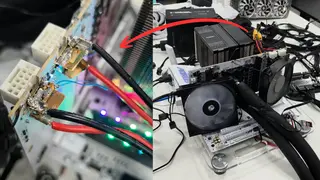
A Brazilian YouTuber known as TecLab removed the heatsink and fans from a high-end Galax RTX 5090D and soldered power wires directly onto the PCB's connector traces. The modified card ran benchmarks at roughly 600 watts while being cooled by an industrial liquid chiller and two zip-tied fans. The experiment highlights the ongoing reliability concerns with Nvidia's 16-pin connector, though the crude soldering introduces its own fire risk.
The Galax HOF OC LAB XOC variant used in the test is an unusual card, supporting dual power connectors and overclocking BIOSes rated up to 2,000 watts. TecLab bypassed both connectors entirely, soldering wire sets directly onto the PCB traces above each port, using adapters to convert standard 16-pin PSU cables into bare wire ends. The crude solder joints held during testing.
Cooling came from an industrial liquid chiller circulating ice-cold water over the bare core, with two 120mm fans zip-tied to the board. A power meter clamped to the 12V rail showed roughly 50 amps, translating to about 600 watts draw. No temperature readings were reported, but the card completed benchmarks successfully.
This experiment underscores how deeply Nvidia's 16-pin connector has eroded consumer confidence in high-end GPUs. While the soldering approach is clearly unsafe for general use, the fact that enthusiasts feel compelled to attempt such modifications could push manufacturers toward more robust power delivery designs. Buyers of premium cards may face ongoing anxiety about component failure, potentially affecting purchasing decisions and trust in flagship products.