Trump's unexpected phone-in to NASA briefing highlights shifting political stakes in space
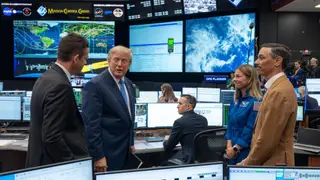
During a post-launch news conference for the Nancy Grace Roman Space Telescope, NASA Administrator Jared Isaacman stepped away to take a call from President Trump, who then addressed the assembled officials and reporters through the phone. The president congratulated the mission team and praised Isaacman's leadership, an unusual direct presidential intervention in a routine NASA briefing. The moment underscores the growing political and military significance of space as NASA faces a future with fewer major missions ahead.
The Roman Space Telescope represents NASA's flagship astrophysics effort for the coming decade, designed to investigate dark energy, exoplanets, and infrared phenomena. Its successful launch comes at a pivotal moment, as the article notes NASA has only one additional major mission on its horizon, leaving the agency's science portfolio facing an uncertain future. Trump's personal engagement, including his Friday visit to Johnson Space Center where he awarded the Artemis II crew and proposed a Space Academy, signals heightened presidential attention to civil space programs.
Isaacman's path to the administrator role was notably turbulent, with Trump withdrawing his nomination over perceived political misalignment before reinstating it months later amid bipartisan support. The administrator's background as a private astronaut and entrepreneur reflects the broader shift toward commercial space involvement in NASA's operations, a trend that has accelerated under the current administration's approach to space policy.
This moment may signal a new era of direct presidential engagement with NASA's routine operations, potentially elevating space science in national priorities. If sustained, this attention could translate into stronger budget support for future missions, benefiting researchers and aerospace workers. However, it also raises questions about politicization of scientific agencies, as mission briefings become platforms for presidential messaging. The public may see space programs increasingly framed through political and military lenses rather than purely scientific ones, shaping how future missions are justified and funded.