NASA's Roman telescope launches to explore dark universe
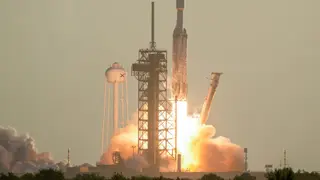
SpaceX launched NASA's Roman Space Telescope on a Falcon Heavy rocket from Kennedy Space Center. The telescope will survey the cosmos with a field of view over 100 times wider than Hubble's, searching for dark energy, exoplanets, and billions of galaxies. It will take more than three months to reach its observation point, where it will join the Webb telescope.
The Roman Space Telescope represents a major leap in cosmic survey capability, with its $4.3 billion cost reflecting the scale of its ambitions. Its infrared camera operates a thousand times faster than Hubble's equivalent instrument, while a specialized coronagraph can block starlight to reveal faint orbiting planets directly, a technique never before attempted at this scale.
Named for NASA's first chief astronomer, the telescope will join Webb at a gravitational balance point roughly a million miles from Earth. Its wide-field survey will target the galactic bulge, dark matter, and dark energy, with a single month of Milky Way observation equaling a century of Hubble's work. The mission will also coordinate with the Euclid spacecraft and Rubin Observatory to cross-check findings.
The Roman telescope's findings could reshape public understanding of the universe's composition, particularly the dark matter and dark energy that remain invisible yet dominate cosmic structure. Its planet-hunting capabilities may accelerate