New climate model scenarios shift focus from baselines to policy pathways
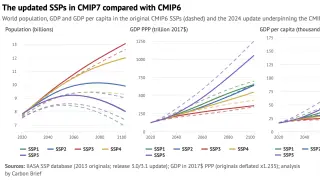
The seventh phase of the Coupled Model Intercomparison Project introduces a new set of emissions scenarios that replace the shared socioeconomic pathways used in previous IPCC assessments. These scenarios are named by their emissions trajectories rather than radiative forcing levels, and they drop no-policy baseline worlds in favor of exploring current policy continuations, strengthenings, or weakenings. High-end emissions projections are revised downward, while low-end scenarios are adjusted upward, making some overshoot of the 1.5C target unavoidable.
EXPANDED:
The new scenario set narrows the plausible warming range considerably. Seven pathways now span 1.6C to 3.3C by 2100, compared with the 1.5C to 4.7C spread in the previous generation. This marks the first time the top of the range has fallen across four modelling cycles, reflecting a judgment that coal-dominated futures are no longer credible.
The scenarios also restructure how futures are framed. They abandon