Satellite Images Reveal Africa's Rooftop Solar Surge Hidden From Official Counts
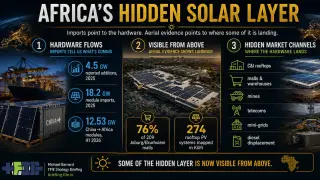
Africa imported 18.2 GW of solar modules in 2025 but officially added only 4.5 GW, a gap suggesting significant unrecorded deployment. Satellite imagery of Johannesburg-area shopping malls shows rooftop solar on 76% of them, indicating that customer-side installations are outpacing official statistics. The trend is driven by cheap Chinese panels, falling battery costs, and unreliable grids, with another 12.53 GW shipped in the first half of 2026.
The import-versus-installation gap in Africa is substantial: roughly 18.2 GW of solar modules entered the continent in 2025, yet official records logged only 4.5 GW of added capacity. Satellite analysis of 209 shopping malls across Johannesburg and Ekurhuleni found rooftop panels on 76 percent of them, offering visual confirmation that commercial customers are deploying systems outside formal tracking channels. Another 12.53 GW of Chinese modules shipped to Africa in the first half of 2026.
This pattern aligns with market fundamentals rather than utility planning. Cheap Chinese panels, declining battery prices, and unreliable grids make self-generation economically attractive for businesses with large daytime loads and capital access. Unlike Pakistan's residential-heavy surge, African evidence points toward commercial, industrial, and institutional installations, though satellite imagery struggles to capture smaller rural systems, telecom sites, or tree-obscured panels.
This reporting gap could reshape how investors, utilities, and policymakers perceive Africa's energy transition. If unrecorded customer-side solar is widespread, official statistics may understate actual renewable adoption, potentially affecting grid planning, tariff structures, and international climate financing decisions. Businesses gaining energy independence may become more resilient to outages, but could also reduce revenue flows to struggling utilities, creating tension between decentralized generation and centralized grid maintenance that affects electricity access for lower-income populations.