Selective use of genocide label distorts legal definition
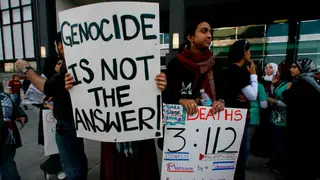
An opinion piece argues that just war theory and genocide are distinct concepts, and that applying the genocide label selectively to Israel's military actions is a political tactic rather than a legal argument. The author contends that civilian casualties in war, even on a large scale, do not by themselves constitute genocide, citing historical examples like Allied bombing in Normandy. The piece concludes that singling out Israel for this accusation aims to delegitimize the Jewish state rather than pursue justice.
The piece grounds its argument in just war theory's long history, noting that even necessary conflicts produce civilian casualties that raise moral questions without meeting genocide's legal threshold of intent to destroy a people. The Normandy example—roughly 50,000 French civilians killed by Allied bombing—illustrates this distinction, as no serious historian has called that campaign genocide.
The author contrasts Israel's situation with other cases: the Assad regime's hundreds of thousands of Syrian deaths, China's treatment of Uyghurs, and mass atrocities across Africa. These, the piece argues, have not drawn the same genocide accusations as Israel's self-defense following the October 7, 2023 massacre, suggesting a discriminatory double standard that the author characterizes as antisemitism.
This argument could shape public discourse by framing genocide accusations against Israel as politically motivated rather than legally grounded. It may influence how audiences evaluate international criticism of Israel's military operations, potentially reinforcing existing partisan divides. The piece's comparison to other global atrocities could prompt broader questions about consistency in human rights advocacy, though critics may view the framing as minimizing civilian suffering in Gaza.