BepiColombo separates into twin probes for Mercury science campaign
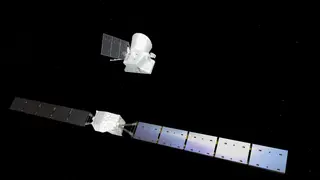
After an eight-year journey, the BepiColombo mission has successfully split into its two science orbiters, marking a key milestone before entering Mercury's orbit in November. The European and Japanese probes will later take separate paths to study the planet's surface, interior, magnetosphere, and test general relativity. Full scientific operations are scheduled to begin in April 2027.
The separation marks the end of a complex cruise phase that began with launch in 2018. During its journey, BepiColombo performed multiple gravity-assist flybys of Mercury, including one in 2021 that brought it within roughly 200 kilometers of the surface. Imagery from that pass revealed extensive lava flows smoothing over ancient crater fields, evidence of the planet's volcanic history.
Once operational, the two orbiters will divide their scientific duties. The European probe will map Mercury's topography and internal structure while testing Einstein's general relativity through precise tracking. The Japanese spacecraft will investigate the planet's magnetosphere and magnetic field interactions with the solar wind. Only NASA's MESSENGER mission has previously achieved orbit around Mercury, making this a rare opportunity to study the solar system's innermost world.
This mission could significantly expand humanity's understanding of Mercury, a planet that remains largely mysterious despite its proximity to Earth. The data may inform comparative planetary science, helping researchers understand how rocky worlds form and evolve under extreme conditions. The general relativity tests could provide subtle refinements to fundamental physics. For the public, the mission's imagery and discoveries may inspire renewed interest in planetary exploration, while the international collaboration between ESA and JAXA demonstrates how shared resources can achieve ambitious scientific goals that no single nation could easily accomplish alone.