Ultra-energetic photon's survival may hinge on hypothetical axion-like particles
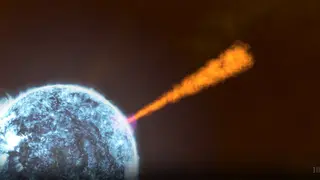
In 2022, a photon carrying 300 tera-electron volts arrived from the brightest gamma-ray burst ever recorded, contradicting standard physics that such high-energy light should be absorbed by cosmic background radiation. Two physicists now propose that interactions with hypothetical axion-like particles could have allowed the photon to traverse the intervening space without being destroyed. Their model offers a potential explanation for this anomalous detection.
The anomalous photon was detected by Russia's Carpet array on October 9, 2022. Its 300 tera-electron volt energy vastly exceeds what Earth's particle accelerators can produce, making it a record-breaking observation from a gamma-ray burst. Standard astrophysics dictates such energetic photons should collide with cosmic microwave background radiation and vanish.
The new hypothesis suggests axion-like particles allow the photon to effectively bypass these interactions. Crucially, the model predicts a time delay. Data from a Chinese observatory showing lower-energy photons arriving an hour earlier aligns with this prediction, lending support to the theory that the universe could serve as a laboratory for testing quantum gravity.
If confirmed, this finding could reshape fundamental physics by providing indirect evidence for axion-like particles and quantum gravity. It may influence how astronomers interpret high-energy cosmic signals, potentially opening a new observational window into physics beyond the Standard Model. The broader scientific community could benefit from a novel way to probe extreme energy scales, though further observations are needed to validate the hypothesis. Society may see increased interest in astrophysical research, as it demonstrates that cosmic events can reveal hidden aspects of reality.