UK government lowers expectations for clean aviation tech, projecting much higher 2050 emissions
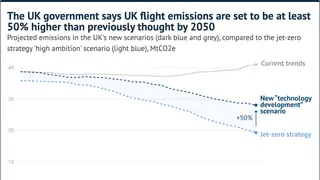
The UK government has revised its aviation emissions forecasts, now expecting 2050 emissions to be nearly 50% higher than previously projected under the 2022 'jet-zero' strategy. The updated outlook assumes a much smaller role for electric planes and sustainable aviation fuels, with only a quarter of emissions cut by 2050. This comes as ministers back a third runway at Heathrow, raising concerns about compatibility with the UK's net-zero target.
The revised projections stem from a newly commissioned analysis by the Aviation Impact Accelerator, which found less optimistic aircraft efficiency gains than earlier assumptions. Consequently, the expected annual efficiency improvement has been cut from 2% to 1.3%.
The government now anticipates sustainable aviation fuels will only account for 30% of the fuel mix by 2050, down from a previous 50% target. Additionally, only the smallest battery-powered planes are expected to be operational by 2035, leaving a significant emissions gap that would require unproven carbon removal techniques to bridge.
This downward revision could place a heavier burden on future generations and taxpayers, as the UK may need to rely on costly, unproven carbon removal technologies to offset stubbornly high aviation emissions. Communities near airports, particularly around Heathrow, may face increased noise and air pollution if expansion proceeds alongside these weaker technological expectations. Policymakers could also find it harder to reconcile airport growth with legally binding net-zero targets, potentially leading to future policy reversals or increased scrutiny of the aviation sector's environmental impact.