Venus's extreme heat explained: atmosphere and reflectivity trump distance from sun
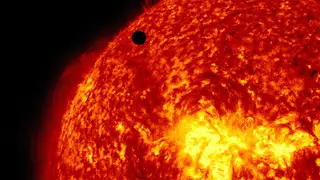
Venus is hotter than Mercury despite being farther from the sun because its thick carbon dioxide atmosphere traps heat, while Mercury lacks an atmosphere to retain warmth. The planet's high reflectivity and geological history also play roles.
Venus sits roughly 67 million miles from the sun, while Mercury orbits at about 36 million miles, yet Venus's surface reaches 900°F compared with Mercury's 800°F peak. The decisive factors are atmospheric density and composition, not solar proximity. Mercury's near-total lack of atmosphere lets daytime heat escape instantly at nightfall, producing swings exceeding 1,000 degrees. Venus, by contrast, is wrapped in a carbon dioxide atmosphere about 90 times denser than Earth's, with sulfuric-acid clouds reflecting roughly three-quarters of incoming sunlight. The CO₂ repeatedly absorbs and re-emits infrared radiation escaping the surface, creating a runaway greenhouse effect that keeps temperatures nearly constant across the entire planet.
Astrophysicist Stephen Kane notes that distance only determines how much sunlight arrives; reflectivity, heat retention, and atmospheric circulation can matter just as much, or more. Venus's geological history produced this dense atmosphere, while Mercury's small mass and weak gravity could never hold one. These contrasting planetary conditions illustrate why proximity to a star alone cannot predict surface temperature.
This explanation could reshape how the public understands planetary climate mechanics, reinforcing that atmospheric composition—not just solar distance—drives temperature outcomes. Educators may use Venus as a vivid case study for greenhouse effects, potentially strengthening climate science literacy. The story may also influence how space agencies prioritize future Venus missions, as its extreme environment offers a natural laboratory for studying atmospheric physics. General readers could gain a more nuanced appreciation of how planetary conditions vary dramatically, which may inform broader discussions about habitability and Earth's own climate systems.