Fossilized feather in coprolite offers clue to bird survival after asteroid
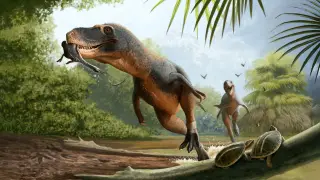
A remarkably preserved feather found inside 66-million-year-old dinosaur feces is the finest specimen from the age of dinosaurs. It belonged to an extinct bird with primitive insulating plumage, suggesting that more advanced feathers helped the ancestors of modern birds endure the post-impact winter. The discovery provides new evidence for why only one bird lineage survived the mass extinction.
The coprolite, a reddish-brown nodule roughly the size of a golf ball, was recovered from the Hell Creek Formation in northeastern Montana—a site that had yielded no feathers in over a century of searching. CT imaging at a USC medical facility revealed the feather's full structure within the fossilized feces, confirming the specimen's exceptional preservation.
The feather belonged to an extinct bird with more primitive insulating plumage. Researchers propose that the ancestors of modern birds possessed more advanced feathers, which may have provided superior insulation during the post-impact winter. This contrast in feather quality offers a plausible mechanism for why only one bird lineage survived the Cretaceous mass extinction.
This discovery could reshape scientific understanding of evolutionary resilience during catastrophic climate events. It may inform how researchers evaluate extinction risks for modern bird species facing rapid environmental change, particularly those with limited adaptive capacity. The finding also demonstrates how overlooked fossil materials, such as coprolites, can yield unexpected insights, potentially encouraging broader examination of such specimens in museum collections worldwide.