New calculations tighten the search for Venus's unknown UV-absorbing substance
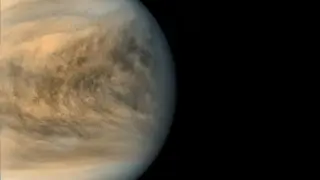
Researchers used radiative-transfer modeling to estimate how strongly the liquid inside Venus's cloud droplets must absorb ultraviolet and blue light to match observations. They considered what the cloud material would look like if collected as a bulk liquid, which changes its appearance. The results sharply reduce the range of possible compositions for the 'unknown absorber' and could guide future spacecraft measurements.
The team's approach reframes a remote-sensing problem as a laboratory measurement question. Because Venus's cloud particles scatter sunlight so efficiently, the brightness seen from space does not directly reveal how strongly the droplet liquid absorbs light. By converting telescope observations into absorption coefficients—the standard unit used in lab UV-visible spectroscopy—the researchers created a direct comparison point for future experiments.
The cigarette smoke analogy illustrates why this distinction matters: smoke appears white due to particle scattering, yet the collected material is dark and tar-like. Venus's cloud particle size distribution resembles smoke's, meaning the pale yellow clouds could contain surprisingly dark liquid. The findings, published in Astrobiology, narrow the candidate substances to those matching the calculated absorption strengths, potentially guiding instrument design for upcoming Venus missions.
This work could sharpen the focus of future Venus missions, helping spacecraft instruments target specific chemical signatures rather than searching broadly. A definitive identification of the unknown absorber may deepen understanding of Venus's atmospheric chemistry and cloud formation processes, with possible implications for comparative planetary science. Researchers studying exoplanets with similar sulfuric acid clouds could also benefit. The findings may influence how scientists interpret remote observations of hazy worlds, though practical applications remain distant and dependent on continued space agency investment.