Hubble Reveals Stellar Nursery Torn Open by Young Stars in Neighboring Galaxy
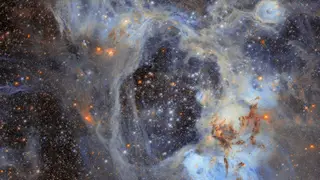
A new Hubble Space Telescope image shows the N44 nebula, a vast cavity about 210 by 140 light-years across, located 160,000 light-years away in the Large Magellanic Cloud. The cavity, known as a superbubble, was carved by intense stellar winds and supernova explosions from massive stars, which compressed surrounding gas and dust into a dense shell. Within that shell, nearly 30,000 newborn stars are forming, illustrating a cycle where destructive forces also trigger new star birth.
The N44 superbubble spans roughly 210 by 140 light-years, a scale that dwarfs the 4.4 light-year distance to Alpha Centauri. The cavity results from massive stars' winds and supernova explosions pushing gas outward, compressing it into a dense shell where new star formation occurs.
The image contains nearly half a million stars, with about 30,000 being young protostars not yet fusing hydrogen in their cores. This concentration offers astronomers a rare opportunity to study star formation timescales — a fundamental question about how stars like our sun come into being.
This image may deepen public understanding of how destruction and creation are linked in cosmic processes. It could reshape how educators explain star formation, showing that violent stellar activity isn't purely destructive but also generative. For astronomers, the data may refine models of stellar evolution and star formation rates. The visual appeal of the image could also inspire broader interest in space science among general audiences, potentially encouraging more engagement with astronomy as a field.