Three-Nail Hanging Puzzle: A Topological Challenge
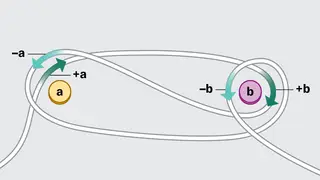
The puzzle asks how to hang a picture on three nails so that removing any two nails drops it, but removing one does not. A solution involves wrapping the string around each nail in a balanced sequence of clockwise and counterclockwise turns. The article also poses a harder variant where removing any single nail causes the fall.
The puzzle builds on a classic two-nail solution, where a string sequence like +a+b−a−b ensures that removing either nail releases the picture. For three nails, the balanced sequence +a+b+c−a−b−c works because each nail has equal clockwise and counterclockwise wraps, so removing any two leaves the remaining nail’s wraps canceling out. The article notes that this is among the shortest solutions, since each nail must be wrapped at least once and wraps must balance. A harder variant, requiring removal of any single nail to drop the picture, has a separate solution: +c+a+b−a−b−c+b+a−b−a. These problems belong to a broader field of picture-hanging puzzles, which explore topological and group-theoretic principles in everyday objects.
This puzzle may appeal to educators and puzzle enthusiasts, offering a hands-on way to introduce abstract concepts like group theory and topology. It could also inspire hobbyists to explore mathematical reasoning through physical challenges, potentially increasing public engagement with mathematics. However, its impact is likely limited to niche audiences, as the puzzle’s complexity may deter casual readers. Still, it demonstrates how simple objects can reveal deep mathematical structures, possibly encouraging more people to appreciate the elegance of formal logic in daily life.