Black hole outflows pack 100 times more energy than previously estimated
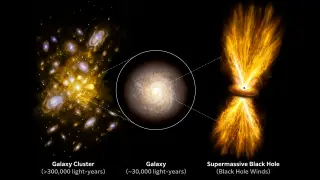
New XRISM data on quasar H1821+643 show that winds from its supermassive black hole carry about a hundred times more energy than earlier estimates. The turbulence extends roughly 300,000 light-years, well beyond the host galaxy, and the total energy output is comparable to billions of supernovae. This suggests black holes can shape cosmic structure on a much larger scale than assumed.
The XRISM satellite's high-precision measurements tracked iron ion emission lines to gauge how hot gas moves around quasar H1821+643, located roughly 3.4 billion light-years away in the constellation Draco. The supermassive black hole sits within a galaxy cluster, where it actively consumes material and produces the intense brightness characteristic of quasars.
The research team, led by Satoshi Yamada at Tohoku University's Frontier Institute for Interdisciplinary Sciences, included collaborators from Kanazawa University and Tokyo Metropolitan University. Their observations indicate the turbulent gas extends about 300,000 light-years beyond the host galaxy's boundaries, with total energy rivaling several billion supernova explosions.
These findings could reshape how astronomers model cosmic structure, since black holes may play a far more active role in distributing energy across intergalactic space than previously assumed. This may influence future telescope missions and computational simulations of galaxy evolution. For the broader public, it deepens understanding of how the universe's most extreme objects shape their surroundings, potentially enriching educational content and inspiring greater interest in space science.