Volcanic plume from Hunga Tonga found to degrade its own methane emissions
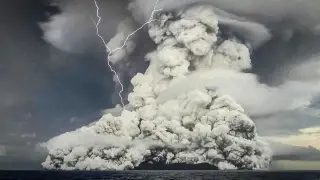
Satellite observations of the 2022 Hunga Tonga eruption revealed unusually high formaldehyde levels in the volcanic plume, a chemical marker that methane was being broken down. The cloud continued destroying methane for over a week as it drifted toward South America. The discovery suggests natural processes could inform new strategies for reducing atmospheric methane and slowing near-term warming.
The eruption released roughly 300 gigagrams of methane, comparable to the yearly output of over two million cows, while the plume simultaneously stripped away about 900 megagrams daily—matching the daily emissions of a similar-sized herd. Researchers tracked the formaldehyde signal for ten days as the cloud drifted toward South America, confirming sustained chemical activity.
The underlying mechanism draws on chemistry first observed with Saharan dust crossing the Atlantic. Volcanic ash mixing with sea salt and sunlight forms iron salt aerosols, which generate reactive chlorine atoms capable of attacking methane molecules. This natural pathway had not previously been linked to volcanic plumes.
This discovery could reshape how scientists estimate volcanic methane contributions to the atmosphere, potentially revising current emissions inventories. If natural methane-destruction processes can be better understood, they may inform future approaches to atmospheric methane reduction, which could slow near-term warming more quickly than carbon dioxide strategies alone. Policymakers and climate researchers may need to account for these natural sinks when modeling future warming scenarios, though scaling such effects beyond volcanic events remains uncertain.