125-million-year-old crocodile fossil shows possible camouflage pattern under UV light
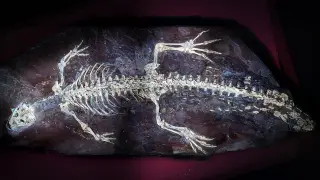
A fossil of Montsecosuchus depereti from Spain, about 125 million years old, has revealed preserved skin, sensory organs, and respiratory structures when examined under ultraviolet light. The UV exposure also exposed alternating bands on the tail that may represent the oldest known coloration in a crocodylomorph. The study was published in the Zoological Journal of the Linnean Society.
The specimen, cataloged as MGB-512, measures roughly 50 centimeters and resides in Barcelona's natural history museum. It was originally unearthed over a century ago at the Pedrera de Meià site, a former karstic lake deposit now recognized as part of a UNESCO geopark. Prior scientific attention in the 1990s did not uncover the soft-tissue details now visible.
Researchers employed ultraviolet light to differentiate fossilized tissues from the surrounding lithographic limestone. This revealed epidermal scales of varying shapes and sizes, plus possible sensory organs concentrated in small scales near the body's margins. Notably, the animal lacked the high caudal fin of modern crocodiles, and a series of alternating bands on its tail hints at the oldest known crocodylomorph coloration.
This discovery may prompt paleontologists to re-examine other historical fossils with UV light, potentially uncovering hidden soft tissues and coloration in specimens previously thought uninformative. For evolutionary biologists, the possible sensory organs and tail pattern could refine models of how ancient crocodylomorphs adapted to aquatic environments. Museums and science educators could leverage this finding to demonstrate the value of re-studying archival collections, engaging public interest in paleontology and the importance of non-destructive imaging techniques.