Aperiodic monotile inspires unexpected chiral light patterns
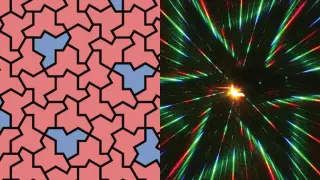
Researchers constructed optical structures based on the Smith hat, a shape that tiles a plane without repetition. Illuminating these structures with laser light produced diffraction effects distinct from those of standard quasicrystals, generating chiral light patterns. The findings suggest new approaches for manipulating light and polarization in optical devices.
The Smith hat, identified in 2023, was the first known aperiodic monotile—a single shape capable of covering a surface without ever repeating. Although its pattern appears irregular, it is built upon the honeycomb lattice. Researchers fabricated nanoscale versions of this arrangement on silicon nitride films using electron beam lithography, then illuminated them with laser light.
The resulting diffraction patterns assumed pinwheel-like forms, exposing chirality—a handedness where a structure and its mirror image cannot be superimposed. Because the monotile arrangement lacks mirror symmetry, the light displayed chiral responses. Reversing the physical structure reversed the optical behavior, confirming a direct link between pattern symmetry and light response, distinct from conventional quasicrystals.
This discovery could influence the design of optical devices that rely on polarization control, such as sensors, telecommunications components, and quantum optics systems. Monotile-based structures may offer compact alternatives to existing chiral optical elements, though practical deployment would require further engineering. The work also highlights how pure mathematical discoveries can unexpectedly inform applied physics, suggesting that other exotic tilings might harbor untapped optical properties worth investigating.