AI model solves 48-year-old sphere-packing puzzle with implications for data transmission
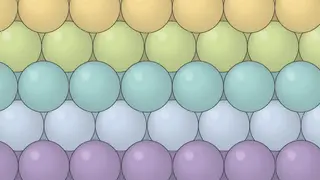
OpenAI's unreleased model Astra reportedly achieved a notable breakthrough in high-dimensional sphere packing, a mathematical problem with direct applications to digital communication. The advance addresses a barrier that had stood for 48 years, according to the company's August announcement. Sphere packing involves arranging spheres efficiently in abstract spaces, and its solutions help prevent errors in transmitted data.
The problem traces back to a simple question about arranging quarters on a tabletop. In two dimensions, a honeycomb pattern achieves optimal density at about 90.7 percent coverage, while three-dimensional stacking—conjectured optimal by Kepler in 1611—was only confirmed in 1998 through a massive computer-assisted proof by Thomas Hales. Beyond three dimensions, the algebra extends naturally, but finding optimal arrangements becomes extraordinarily difficult.
The practical stakes are significant. Efficient sphere packing in high-dimensional spaces directly supports error correction in digital communication, helping prevent transmitted data from becoming garbled. OpenAI's announcement on August 1 stated that its Astra model achieved a notable advance in this area, breaking a barrier that had stood for 48 years, alongside progress on nine other problems in mathematics and theoretical computer science.
This breakthrough could accelerate progress in digital communication, where sphere-packing solutions underpin error-correction codes that keep transmitted data intact. Telecommunications companies and network engineers may eventually benefit from more efficient coding schemes, while mathematicians may gain new tools for tackling other long-standing problems. However, reliance on an AI model raises questions about verification and reproducibility, which could shape how the research community evaluates machine-generated mathematics.