Stunning cosmic snapshots take top prizes in 2026 astrophotography contest
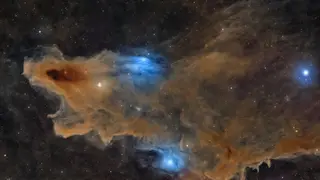
The Royal Observatory in London has announced the winners of its annual astrophotography competition. The overall winner, Ali Alobaidly, captured a dark nebula in the constellation Cepheus after more than 28 hours of observing. Other winners include images of the Helix nebula, a lunar occultation of Venus, and the sun's chromosphere.
The competition spans multiple categories, from deep-sky objects to solar system phenomena. The Shark nebula, located 650 light years away in Cepheus, required over 28 hours of observation time to render its faint dust clouds. The Helix nebula image, captured by Kfir Simon, reveals distant background galaxies shining through the remnant gas of a dying star.
Several winners employed specialized techniques. Peter Ward's solar image combines hydrogen and calcium emission wavelengths to map the chromosphere's structure. Stefano Pellegrini's skyscape used 340 separate 30-second exposures to trace star trails above baobab trees. The comet image, taken during October 2025, shows dual plumes of dust and plasma created by solar proximity. All winning photographs will be displayed at the National Maritime Museum in London starting 18 September.
This competition may inspire amateur astronomers and casual stargazers to pursue astrophotography as a hobby, potentially growing public interest in space science. The accessible nature of many winning images—captured from backyards and observatories rather than space telescopes—could demonstrate that meaningful cosmic observation remains possible from Earth. Such recognition may also encourage educational engagement with astronomy, as schools and science centers could use these images to spark curiosity about nebulae, comets, and solar phenomena.