Colliding ice floes may drive Arctic's unpredictable drift patterns
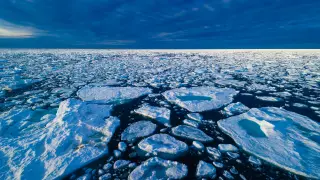
New research suggests that the Arctic's sea ice moves unpredictably because individual ice floes constantly collide and transfer energy to one another. This simple mechanism could explain why ice speeds and spreading rates differ from wind-based predictions. The findings, published in Physical Review Letters, may improve future forecasts of sea ice movement in a warming Arctic.
The research team built a computer simulation treating ice floes like grains moving through a silo, but with the added complexity of floating on water and being driven by turbulent winds. They compared their model against real measurements from the Fram Strait, a passage between Greenland and Svalbard where large volumes of Arctic ice exit toward the Atlantic. Using local wind data and one adjustable parameter, the model reproduced three previously puzzling observations: spreading rates, the range of individual floe speeds, and motion changes over periods from hours to days.
In dense ice fields, collisions occur far more frequently than wind shifts. Each impact dissipates some of the energy supplied by the wind, limiting how far a floe travels before striking another piece. This repeated jostling explains why sea ice does not simply keep accelerating as simple wind-based predictions would suggest, and why it spreads across the ocean more slowly than expected.
Improved understanding of sea ice motion could benefit shipping companies navigating Arctic routes, indigenous communities relying on ice for travel and hunting, and climate researchers modeling global heat exchange. Better forecasts may help vessels avoid hazardous ice conditions and assist coastal planners preparing for changing ice patterns. However, the study's immediate practical applications remain limited, as the model requires further validation across different Arctic regions before operational use becomes feasible.