Ancient fishapod fin reveals unexpected elbow diversity
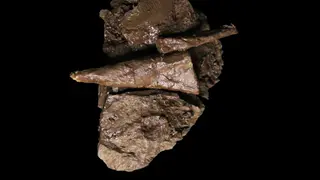
A 350-million-year-old isolated fin fossil from Ellesmere Island shows a pointed forearm bone and a hinge-like elbow joint, differing from known fishapod species. CT scans comparing it with 16 other fishapods suggest it belongs to a distinct species, adding to evidence of varied limb evolution before the first land animals. The find highlights that early arm formation involved considerable trial and error.
The fossil's radius bone was notably long and triangular, tapering to a sharp point where the wrist would be in a tetrapod, offering little support for pushing against the ground. Its elbow end was narrow and bean-shaped rather than rounded, suggesting a hinge joint restricted to a single plane of motion—unlike the twisting, rotating elbows of other fishapods. The intermedium bone, suspected to be a wrist precursor, was also proportionally longer than in Tiktaalik and its relatives.
The discovery adds to a growing picture of evolutionary experimentation among finned tetrapodomorphs, dozens of which have been identified in recent decades. Previous finds like Qikiqtania wakei, described in 2022, showed a fishapod that reverted to full-time swimming after initially developing weight-supporting fins, underscoring that the transition to land animals followed no straight path.
This finding could reshape public understanding of evolutionary transitions, showing that limb development involved considerable trial and error rather than a linear march toward land-dwelling forms. Educators and science communicators may use it to illustrate how paleontological discoveries continually refine our picture of deep time. The research may also influence how museums present early vertebrate evolution, emphasizing diversity and experimentation over teleological narratives.