Icarus Robotics' free-flying ISS robot passes microgravity test campaign
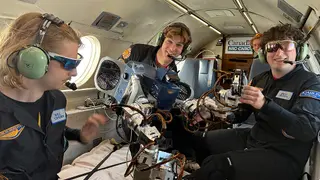
Icarus Robotics completed parabolic flight tests of its Joy robot, logging 66 parabolas and two minutes of weightlessness to validate key systems. The robot, designed to handle cargo and logistics aboard the International Space Station, will be handed over to NASA in January ahead of a planned 2027 launch. The company says all success criteria were met during the campaign, covering manipulation, state estimation, and flight control.
The September test campaign spanned four flights over three days, with each parabola yielding roughly 20 seconds of weightlessness. Joy's seven-degree-of-freedom arms, built entirely in-house, were the primary focus, and the team benchmarked pre-recorded trajectories from terrestrial office runs against identical movements in microgravity to assess performance.
Because teleoperation was unavailable during parabolic flight, Icarus relied on pre-recorded set points gathered from ground testing. The company's $6.1 million seed round, raised last year, has supported the shift from prototype toward production-ready hardware. Joyride-1 will launch under a mission management agreement with Voyager Technologies announced in March.
If Joy performs as intended on the ISS, it could meaningfully reduce the time astronauts spend on routine cargo handling, freeing them for research and mission-critical work. The success may also encourage other robotics developers to pursue parabolic testing as a validation step, potentially accelerating the adoption of free-flying systems in future commercial space stations. However, operational reliability in sustained orbit remains unproven, and the technology's broader impact will depend on how well it translates from brief test windows to real station conditions.