Gravitational lensing could resolve 'forbidden' black hole collision, yet unveils a deeper cosmic puzzle
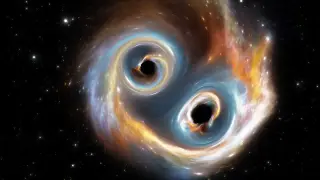
Researchers propose that a gravitational lensing effect, predicted by Einstein's general relativity, may have distorted the signal from a black hole merger, explaining why the colliding objects appeared impossibly massive. This interpretation would resolve the earlier contradiction but introduces a new question about the true nature of the event. The finding highlights how space-time warping can complicate the interpretation of gravitational wave observations.
Gravitational lensing, a consequence of Einstein’s general relativity, occurs when massive objects bend spacetime and distort light or gravitational waves passing nearby. In this proposed scenario, a foreground galaxy or black hole could have magnified and warped the signal from a distant merger, making the component black holes appear far more massive than physically allowed by stellar evolution models. This would resolve the “forbidden” contradiction—but if lensing is confirmed, astronomers must then determine the true masses and distance of the original event, a task complicated by the same warping that misled them. The finding underscores how subtle spacetime curvature can mimic or mask astrophysical phenomena, requiring careful calibration of future detectors.
This interpretation could reshape how gravitational wave events are validated, prompting researchers to develop lensing-aware analysis pipelines for observatories like LIGO and Virgo. If such distortions are common, some previously catalogued extreme mergers may need reclassification, affecting estimates of black hole population and formation channels. For the public, it highlights the universe’s complexity, but also risks overstating certainty in cosmic discoveries. Ultimately, it may foster more cautious reporting of “impossible” findings, benefiting scientific credibility.