Single-celled organism's lightning-fast contraction reveals calcium-powered protein network
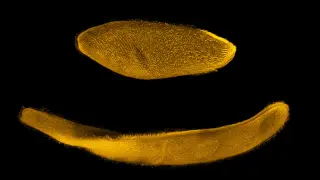
Spirostomum ambiguum, a giant ciliate, can compress to a quarter of its length in under five milliseconds using calcium ions and a fishnet-like protein arrangement. The mechanism is far faster than human muscle contraction. Researchers hope it informs the design of faster artificial muscles.
The organism's contraction speed works out to roughly 100 body lengths per second, and it can repeat the motion rapidly. The myoneme fibers wrap around the cell's exterior in a mesh pattern, and when calcium triggers the Sfi1 protein to lose rigidity, the entire net cinches inward simultaneously, protecting internal structures during the rapid movement.
Unlike human muscle which burns ATP chemically, this organism's system operates more like an electrical switch, with calcium ions serving as the signal. Researchers still haven't identified what generates the initial trigger or how the system recharges between contractions, leaving open questions about the full cycle of this ultra-fast mechanism.
The discovery could influence robotics and prosthetics, where faster artificial muscles would enable more responsive devices. Medical applications might include micro-scale tools for surgery or drug delivery. However, translating this biological mechanism into engineered systems remains a distant goal, and any practical impact would likely emerge gradually over years of materials science research.