Swedish startup's AI drone autonomously selects and strikes targets in demo
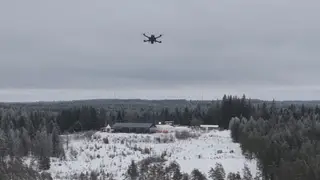
Scaleout Systems, a Swedish AI startup, demonstrated a loitering munition that autonomously identified, ranked, and attacked an armored vehicle using an Nvidia Jetson Orin Nano and onboard computer vision. The drone completed its mission in under 320 seconds without any external communication, relying on human-set parameters and a failsafe controller. The project, part of NATO's DIANA accelerator, uses federated learning to adapt models locally and is designed to resist electronic warfare.
Scaleout's system pairs a BAE Systems Bofors loitering munition with an Nvidia Jetson Orin Nano running the YOLOv8 Nano object-detection model, achieving roughly 30 frames per second at about 20 meters per second with sustained latency near 30 milliseconds. The company's federated learning approach, called the Tactical Computer Vision Network, lets onboard devices train locally and share model updates, which the firm says enables rapid adaptation without relying on external connections. Prior demonstrations include an arctic strike test at -18 degrees Celsius and a Swedish Air Force exercise where a lab node kept full-rate inference while offline, logging detections locally and backfilling data upon reconnection. The project receives 100,000 euros in funding through NATO's DIANA accelerator program.
Autonomous strike capabilities like this could reshape military engagement norms, potentially reducing risk to personnel while raising concerns about accountability when machines select targets. Civilian populations near conflict zones may face heightened uncertainty if drones operate without human confirmation, though failsafe controllers and preset parameters offer some oversight. The technology's resistance to electronic warfare could also alter how adversaries approach jamming, possibly escalating countermeasures in contested environments.